It was a drizzly, foggy day in Seattle—perfect weather for a visit by kayak to the waterfront along Elliott Bay.
I launched from Jack Block Park in West Seattle. A sign at the launch beach said “30-minute parking.” Longer-term parking was available in another, less convenient part of the park, 400 yards (365 m) away.
A Port of Seattle groundskeeper told me I could safely ignore the 30-minute parking sign and simply park at the nearer location. It was tempting to trust him, but I’ve been burned before by junior parks employees who told me to ignore parking signs, only for more senior employees to write me a ticket for disobeying the signs. I thanked the groundskeeper for the tip, but I dropped my kayak off on the beach and then parked in the longer-term lot.
Elliott Bay was a busy place on a Friday morning. Container ships anchored in the bay, waiting for berths to open up in the waterways alongside Harbor Island, where cranes were unloading other ships that had arrived earlier. A lumbering bulk carrier eased its way toward the grain elevator at Pier 86. Ferries, both passenger and vehicular, zipped back and froth across the bay. The harbor patrol were conducting an exciting drill in which they practiced chasing down a fleeing motorboat and arresting its operator.
I had to keep my wits about me to avoid getting run over in all the commotion. Even though I was on my best, most seamanlike behavior, I was still honked at twice by other boats—once by the Kitsap Transit fast ferry and once by the Leschi, a 108-foot (33 m) fireboat belonging to the Seattle Fire Department. Next time I’ll bring an airhorn so I can cheerfully return my fellow mariners’ salutes.
Seattle waterfront seen from Elliott Bay. Like many Seattleites, I was skeptical of a big, light-up ferris wheel when it was first proposed, but I have since come to love it.
Seattle Aquarium’s Ocean Pavilion. This new extension to the aquarium houses species from the tropical western Pacific.
M/V Cape Kortia at anchor in Elliott Bay. This 330-meter-long (1,080 feet), 48-meter-wide (156 feet), 11,000-TEU container ship is built to the “New Panamax” specification, meaning it can transit the Panama Canal’s third set of locks which opened in 2016 but not the original two sets of locks which opened in 1914.
Kayaking under barge. Two ocean-going barges from Hawaii were anchored off Jack Block Park.
The water of Elliott Bay was a muddy brown, courtesy of the historic floods underway throughout western Washington. Even on Friday, the Duwamish River was at 19.8 feet (6 m) at the Tukwila river gauge, where it is usually around 10 feet (3 m) or less. By Monday, the river reached 20.6 feet (6.3 m). A levee along its chief tributary failed, resulting in dangerous flooding south of Seattle.
The discoloration of the water was so pronounced that a tourist from Vancouver, BC, walking along the waterfront past the Olympic Sculpture Park, stopped to ask me if the water in Seattle is always this “dirty.” I assured him that the water in Seattle is normally a clean, lovely blue color and suggested that even the water of his own home river, the Fraser, might also be discolored at the moment due to the region-wide flooding.
Hearing the name of his hometown seemed to provoke the Vancouverite. He began fuming about how much he hated “socialism” and all the “socialists” he had to deal with back home, at “both the provincial and federal level.” I considered informing him that Seattle had recently elected a democratic socialist to be sworn in as mayor next month, but on second thought, I decided this man was already juggling about as much socialism as he could healthily handle. I wished him the best of luck and paddled quickly around the corner.
Besides right-wing Vancouverites, our other notable visitors were the wintertime seabirds. I saw both species of goldeneye, a large raft of surf scoters, common loons, western grebes, and pigeon guillemots, all in their winter plumages.
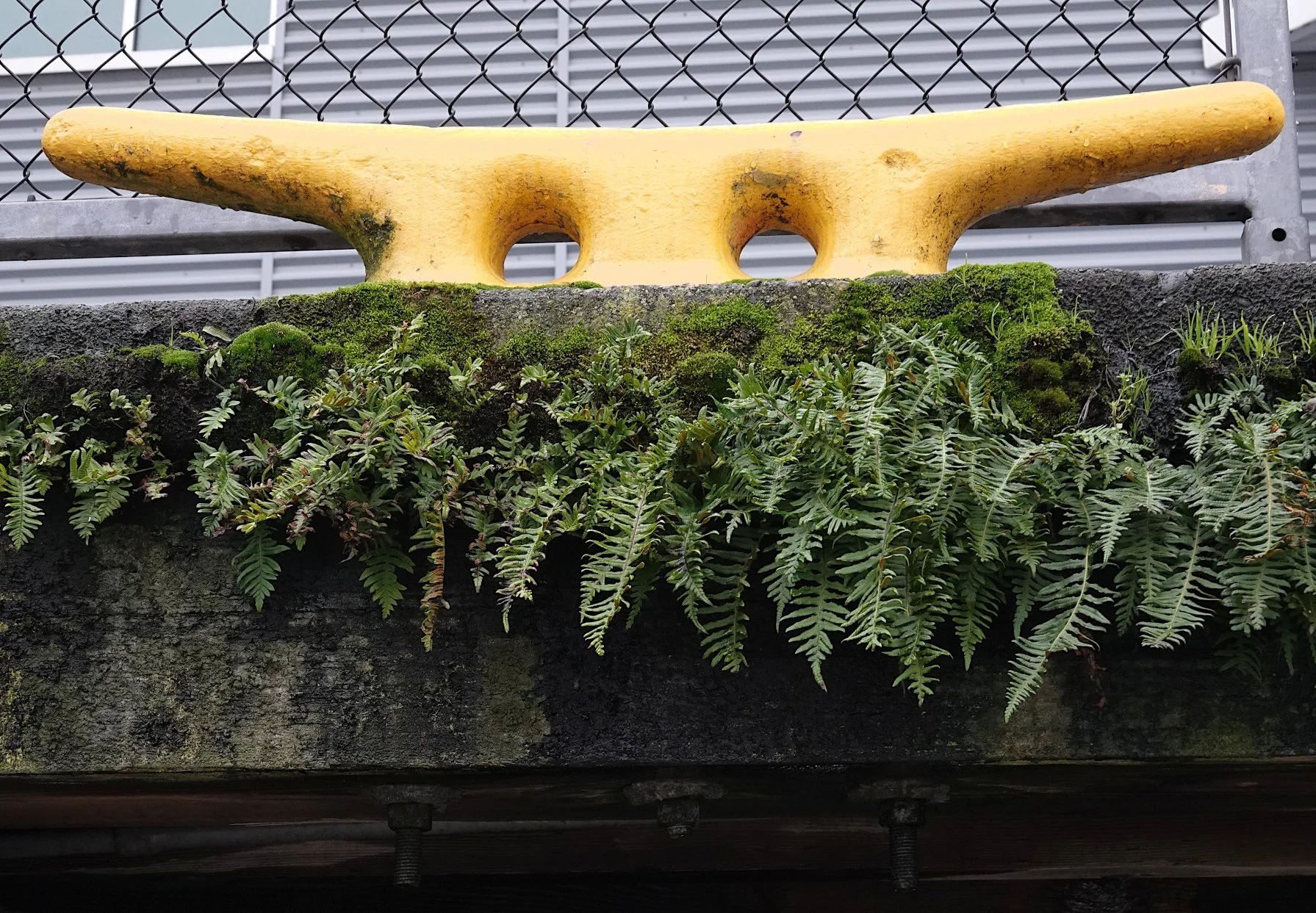
Licorice ferns hanging beneath cleat on Pier 70. Even piers currently housing non-water-dependent tenants, such as Pier 70 with its commercial offices and pub, remain equipped to handle vessels someday if needed.
Echo, by Jaume Plensa, Olympic Sculpture Park. The forty-six-foot (14 m) sculpture is made of polyester resin on a steel frame, coated with marble dust.
United by Nature, by INO, 1306 Western Ave. Seattle commissioned this and other murals around town in preparation for hosting part of the 2026 FIFA World Cup, including the “Pride Match” set to be played in Seattle on 26 June in honor of our LGBTQ+ community, at which the two teams to take the field will be the Arab Republic of Egypt and the Islamic Republic of Iran.
Hub of the Seattle Great Wheel. The lights on the wheel are always illuminated, day and night, year upon year, blinking and blinking, round and round and round.
Short-billed gull, Bell Harbor Marina. This and the glaucous-winged were the only species of gull I saw today.
Barrow’s goldeneye, Elliott Bay. I saw around forty Barrow’s goldeneyes and half a dozen common goldeneyes.
Western grebe, Elliott Bay. This species is the largest North American grebe.
The chief attraction of paddling the Seattle waterfront is the opportunity to paddle under the piers. Many of the most famous landmarks along the waterfront are built on piers over the water, including the Seattle Aquarium and the Seattle Great Wheel. While tourists walk overhead, a kayaker can creep around through the dark maze beneath.
It was high tide when I arrived at the waterfront. Some of the piers were so low to the water my boat wouldn’t fit under the structures. In other places, the boat would fit but I would not. Cables and pipes beneath some of the piers forced me to lean all the way back onto my deck like a floating limbo dancer. Even then, my hat was knocked off my head and into the water during one of the passages. After that, I set my hat on the deck during the tighter squeezes, but one pipe was so low overhead that it still knocked my hat off the deck.
At one point, I found myself in a dead-end of pipes so tight that I wasn’t sure I’d be able to back my way out. What if I was trapped, in the dark, underground? In a worst-case scenario, I’d have to wait for the tide to drop to open up more headroom.
Kayaking under Pier 68. A kayak is the only vessel with the versatility to explore all parts of the waterfront.
Kayaking under Pier 70. The pilings along the waterfront are a mixture of ancient creosote-coated wood and modern concrete and steel.
Kayaking Bell Street Pier Cruise Terminal. This being December, no cruise ships were in port today.
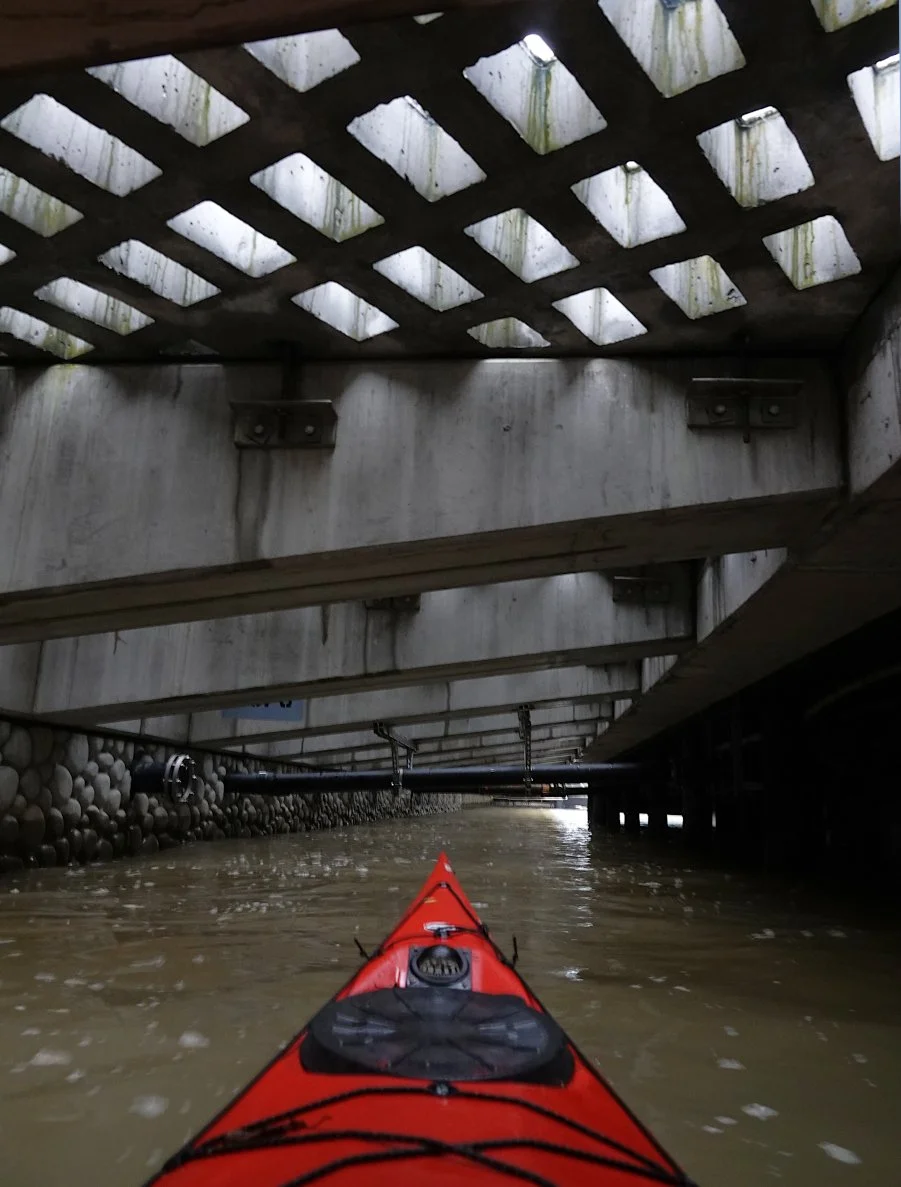
Kayaking under the Seattle Aquarium. The glass prisms overhead are intended to transmit light for the benefit of juvenile salmonids.
Kayaking under Jellyfish Playground. People walking overhead were visible by the shadows they cast through the glass prisms.
Kayaking past Colman Dock. Vehicular ferries depart from here to Bremerton and Bainbridge Island, and passenger ferries to Bremerton, Kingston, Southworth, Vashon Island, and West Seattle.
Each time I do this trip, I find something new to appreciate. This time, I enjoyed the challenge of picking my way in and out of the low, tight spaces beneath the piers, like a strange sort of water creature navigating a maze. Seattle is a city of some 780,000 people, but not one of them shared my perspective on the waterfront.
—Alex Sidles