Wintertime kayaking in Washington is often constrained by wind. This time of year, low-pressure cyclones frequently blow in off the ocean, bringing with them strong surface wind that can make kayaking uncomfortable or even dangerous.
Just such a storm was in the forecast this weekend, but the storm track was bending more toward the northern half of our waters. Down in south Puget Sound, the storm might bring rain, but it likely wouldn’t bring much in the way of wind.
Harstine Island is about as far south as it is possible to paddle in Puget Sound. It’s also a longstanding wintertime favorite of mine. It was time for a visit.
Route map. I arrived at Joemma Beach State Park two hours before the park’s opening, but it turned out the gate barring the entrance was unlocked.
Wind indeed turned out to be calm here in the sheltered waters of Puget Sound. As for the rain, it began just as I was packing my boat at the launch beach and did not let up until I arrived at my campsite on Hope Island. It was no matter. Rain is of scant concern to a kayaker.
There were two other kayakers paddling and hiking around Hope Island when I arrived, but they didn’t stay overnight. By mid-afternoon, I had the whole island to myself. I took a walk around the forest trail that circles the island.
View down Pickering Passage from under Harstine Island Bridge. The only time I could use my camera during the steady rain was while passing beneath the bridge connecting Harstine Island to the mainland.
Forest trail around Hope Island. The undergrowth here is mostly evergreen huckleberry, rather than the salal one finds on islands farther north.
Foggy forest, Hope Island. The island was logged and farmed by settlers for many decades, but the forest is now starting to recover its original majesty.
Western redcedar, Hope Island. Some of the cedars here are culturally modified trees, but my untrained eye struggled to detect the traces.
Western hemlock growing from nurse log. The stump that once elevated this tree above its rivals when it was a seedling has now almost completely decayed, leaving the tree standing on tall, skinny legs.
Spring comes early down here at sea level. Signs of its approach were already everywhere: singing house finches, budding leaves, and seabirds changing into their breeding plumages. Last time I was on Hope Island in February, I found daffodils, but I may have been a couple weeks too early this time.
There was a bit of a breeze in the later afternoon, and the air was cold. I set up camp in one of the more protected campsites, even though it meant I wouldn’t be able to look out over the water. Weather stations farther north reported winds into the mid-thirties, so I was pleased with myself for having come to the more sheltered south sound.
In the middle of the night, I awoke to the yapping and howling of a family of coyotes. The volume was very loud, but I couldn’t be certain whether the coyotes were with me on Hope Island or, as I think more likely, across the channel on nearby and much larger Squaxin Island, where I have seen coyotes before.
“Island Belle” grapevine growing up trunk of Douglas-fir. Grapes planted by settlers in the 1890s have gone feral, struggling to hold their own against the encroaching forest.
Spiderweb high in trees. Birds and spiders alike were at work in the forest, hunting for newly hatched insects.
Branch of Pacific madrone, buried in sand. The bark of this species turns all different shades of green and red, depending on the tree’s age and health.
Grand fir needles. This species has one of the sweetest smells of all our native firs.
Golden waxy-cap. This was the only species of mushroom I saw.
Sitting on mud bank, Hope Island. I had forgotten to bring a tarp or waterproof hiking boots, but fortunately the rain subsided over the course of the day.
Bird species in the forest included brown creeper, chestnut-backed chickadee, red-breasted nuthatch, Oregon junco, Pacific and Bewick’s wrens, song sparrow, spotted towhee, northern flicker, and American robin—a typical wintertime species composition for an island in Puget Sound.
On the water, the most numerous species were common and Barrow’s goldeneyes, surf scoter, common and red-breasted mergansers, double-crested and pelagic cormorants, common loon, red-necked and horned grebes, pigeon guillemot, and common murre. The best bird of the trip was a single long-tailed duck, swimming slowly a few hundred meters southeast of Hope Island.
I was drinking tea down on the beach when I heard a loud, chirping call. It sounded a little bit like an osprey or perhaps a nestling eagle, except louder than any I’d ever heard. I turned around to face the forest, scanning the treetops, when I heard it again, this time from behind me, out on the water. To my surprise, it was a large river otter, swimming just offshore and chirping loudly every time it stuck its head above water.
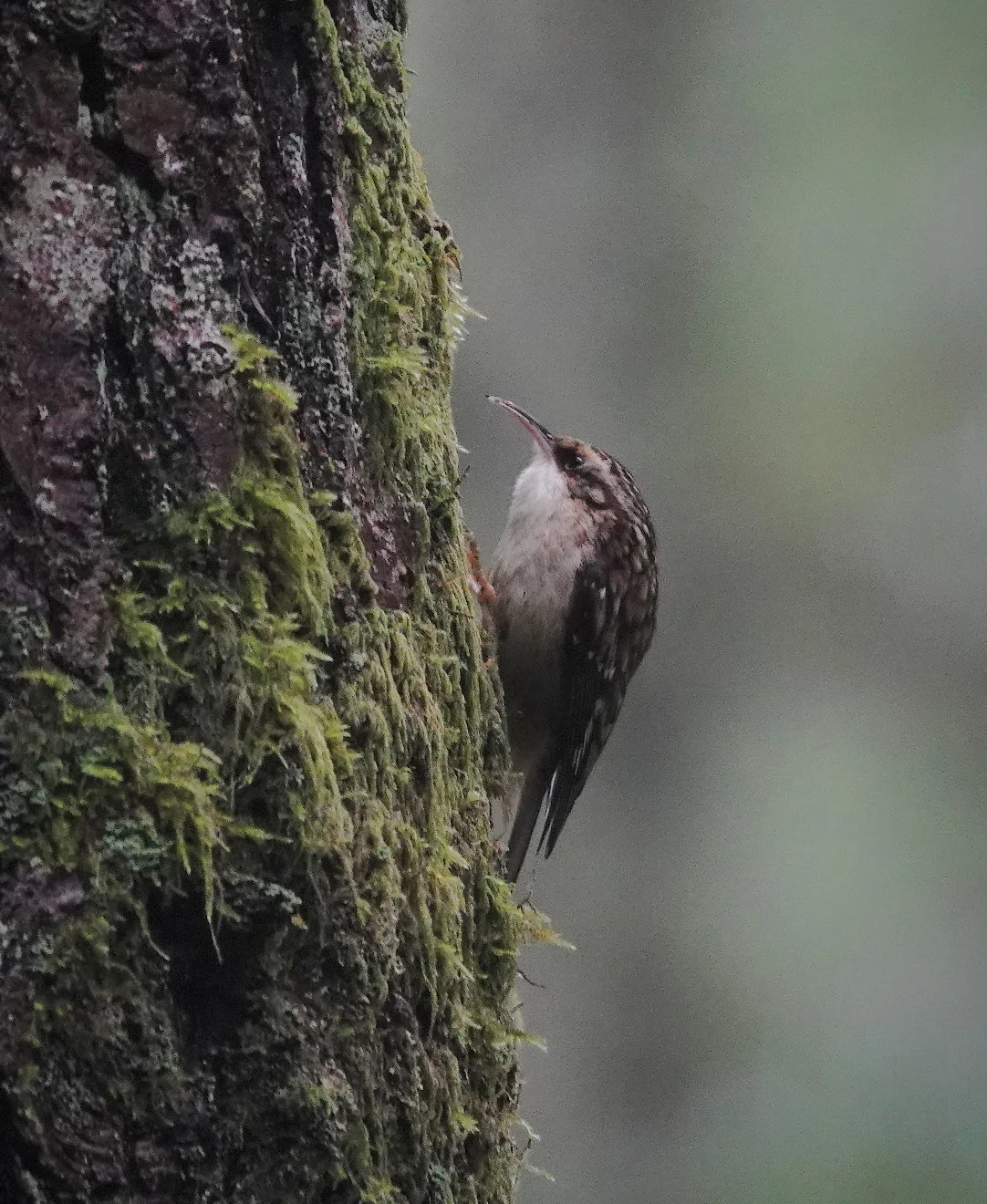
Brown creeper, Hope Island. The brown creeper is widespread in North America, but it can be hard to spot deep in the forest.
Pacific wren, Hope Island. This individual skulked around in the bushes for a few minutes then flew up onto a low snag and burst into song.
Double-crested cormorant on mooring buoy off Hope Island. In the absence of yachties, the cormorants made themselves at home.
Cormorants on beacon off Harstine Island. Cormorants are among our most sociable seabirds.
Long-tailed duck off Hope Island. This handsome sea duck breeds in the arctic but winters as far south as Washington.
Pigeon guillemot burrow, Harstine Island. Unbeknownst to the homeowners on top of the bluff, seabirds are hard at work below, tunneling into the cliff face, undermining the foundations, reclaiming Harstine Island inch by inch.
Kayaking up Case Inlet toward Joemma Beach. Currents worked against me more often than not, but never faster than about a knot and a half and usually less than that.
It can be fun to brave strong winds and icy conditions, but winter kayaking can also mean strolling through a forest all alone, listening to the birds and watching the fog drift between the trees. There are a lot of different styles of kayaking. I pick whichever one suits me at the moment.
—Alex Sidles