Whenever Rachel and I take the kids, Maya and Leon, kayaking-camping, we like to let them pick the destination. This time, the kids picked Hope Island in south Puget Sound.
With the possible exception of Sucia Island in the San Juans, Hope Island is the best kayak-camping island in the state for children. The crossing is short, the landing is easy, the campground is sheltered, and there are lots of places on the island to explore.
Route map. Parking at Boston Harbor is free, but it requires a Discover Pass from the State of Washington, which runs US$45 per year.
I hadn’t looked at a tide table prior to the trip. Currents in south Puget Sound are generally mild, so it wasn’t something I was worried about. Still, I was pleasantly surprised when, launching at 5:30 in the afternoon, we encountered a steady, favorable current pushing us northward toward Hope Island. Hope Island is only just over three miles (5 km) by kayak from Boston Harbor, but even on a short crossing, it’s better to have assistance than resistance.
Rachel and Leon in kayak off Boston Harbor. Leon took a few strokes with the paddle, but he was mostly content to let Rachel do the paddling.
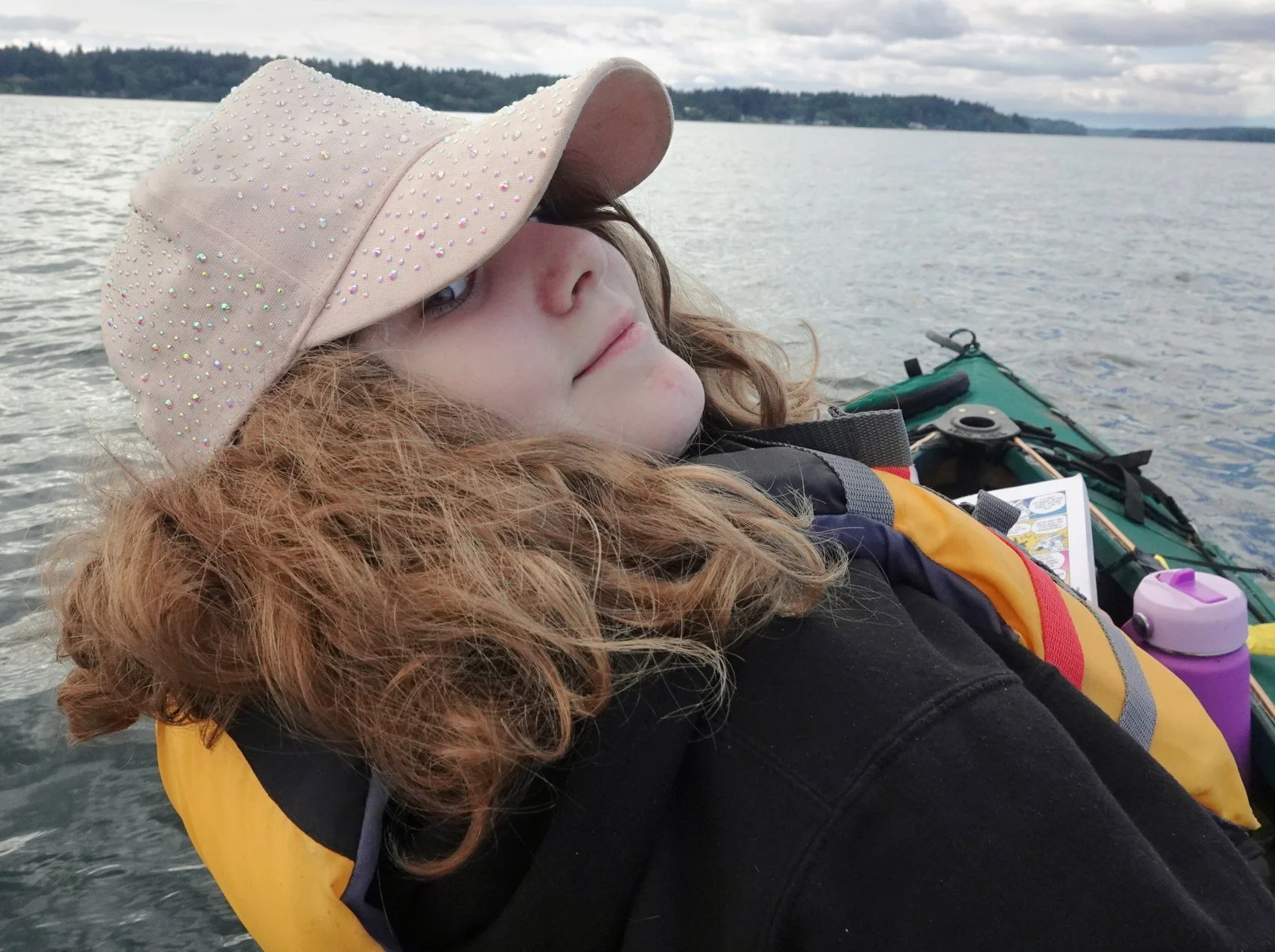
Maya in kayak off Hunter Point. Maya brought plenty of books and toys in the boat, but her main entertainment was listening to “dog stories” that I would make up, all about the adventures of her pack of stuffed dogs.
Leon talking to Rachel in kayak. Even though we were only camping for two nights, we carried so much stuff that some of it had to go on deck.
Harbor seals at Boston Harbor. Boston Harbor is a popular launch for kayakers, so these seals were totally unperturbed by our passage.
Arriving early on Friday evening, we found only one other person camped on Hope Island, a paddleboarder who had crossed from Arcadia. The launch at Arcadia is even closer to Hope Island than Boston Harbor is, but it’s also a longer drive from Seattle. I’ve only used Arcadia once, on a trip with Maya and a couple friends when Maya was not yet four years old.
The paddleboarder was sleeping out under the stars rather than in a tent. Normally, it’s a lovely thing to do, but not this weekend. This weekend, Hope Island was buzzing with mosquitoes. I’d never seen mosquitoes in any numbers on Hope Island, so I was surprised to see them now. I’m not sure why there were so many; maybe something to do with the recent rain. In any event, the paddleboarder had to flee her campsite in the woods in favor of the beach to get away from the mosquitoes. A few of them followed her even to the beach.
More people came on Saturday night. They arrived in all sorts of conveyances: powerboats, sailboats, plastic rec kayaks, fiberglass canoes, inflatables, and even two sailing dinghies full of girls from Camp Gallagher in nearby Case Inlet. The ranger told us it was the first night this year when all campsites on Hope Island were occupied.
Leon setting up tent. At age six, Leon was now tall enough to reach all but the very highest clips on the tentpoles.
Maya and Leon in camp. We kept a sharp eye out for raccoons, which in past years have been a plague on Hope Island, but we didn’t see a single one.
Looking up at Douglas-fir forest on Hope Island. The forest here is second-growth, but a very handsome second-growth.
Old farm equipment, Hope Island. The island was farmed during the first thirty years of the twentieth century, before transitioning to a tree farm and vacation property.
The chief attraction on Hope Island—and something I myself only discovered in recent years—is the feeding of the deer. A large orchard on the south end of the island attracts local black-tailed deer to forage for fallen apples. If there aren’t enough apples on the ground, you can pick them from the trees and toss them to the deer.
Mid-July was too early for fallen apples. We weren’t even sure how big the apples on the trees would be. We brought a sack of store-bought apples, just in case we couldn’t find enough local apples to feed the deer.
We needn’t have worried. The apples growing in the orchard were not ripe enough to fall on their own, but they were plenty large enough to be picked. The kids climbed on the picnic tables to reach the lowest branches. They harvested dozens of apples and began tossing them to the deer.
Deer are not predatory animals. They don’t have much of a chase instinct. If an apple rolled right up to a deer, it would spot it and eat it, but if it rolled too far past the deer, the deer would take a few hesitant steps after it and then give it up as lost. The kids gradually improved their apple-tossing accuracy over the course of the weekend, sometimes managing to roll an apple directly into a deer’s leg or even bounce it off a hummock to hit a deer in the flanks.
Maya and Leon and deer in orchard. The deer didn’t mind the hot sun, but the kids and I were happiest in the shade under the trees.
Maya picking apples. The kids named the three friendliest deer “Maple,” “Daisy,” and “Juicy,” the latter so called for the apple juice that dribbled from its mouth as it chewed.
Deer picking up apple. There seemed to be no limit to the number of apples each deer could eat.
Deer chewing. Other than deer, the only mammals we saw were harbor seals and Douglas squirrels.
There were lots of other things to do. The kids and I made up a football variant we called Saka, which involved using the apple trees in the orchard as goals. Since a goal could be scored on any side of a goal-tree, the two kids enjoyed a decisive advantage over me by myself, in that they could circle around to opposite sides of my tree while I ran haplessly back and forth.
Down on the beach, we looked for shore crabs under the rocks. The beach on Hope Island is mostly small gravel, which is not suitable for crabs, but that only meant the crabs were forced to congregate under the handful of larger rocks. We would often find twenty or more crabs under even a fist-sized rock.
Rachel hiked the mile-and-a-half-long (2.5 km) trail around Hope Island. It’s one of the best hikes in Washington for studying native plants, which is one of Rachel’s hobbies. She returned with a handful of vanilla-leaf seeds to try planting in our yard. If they grow, the dried leaves emit a sweet, vanilla fragrance.
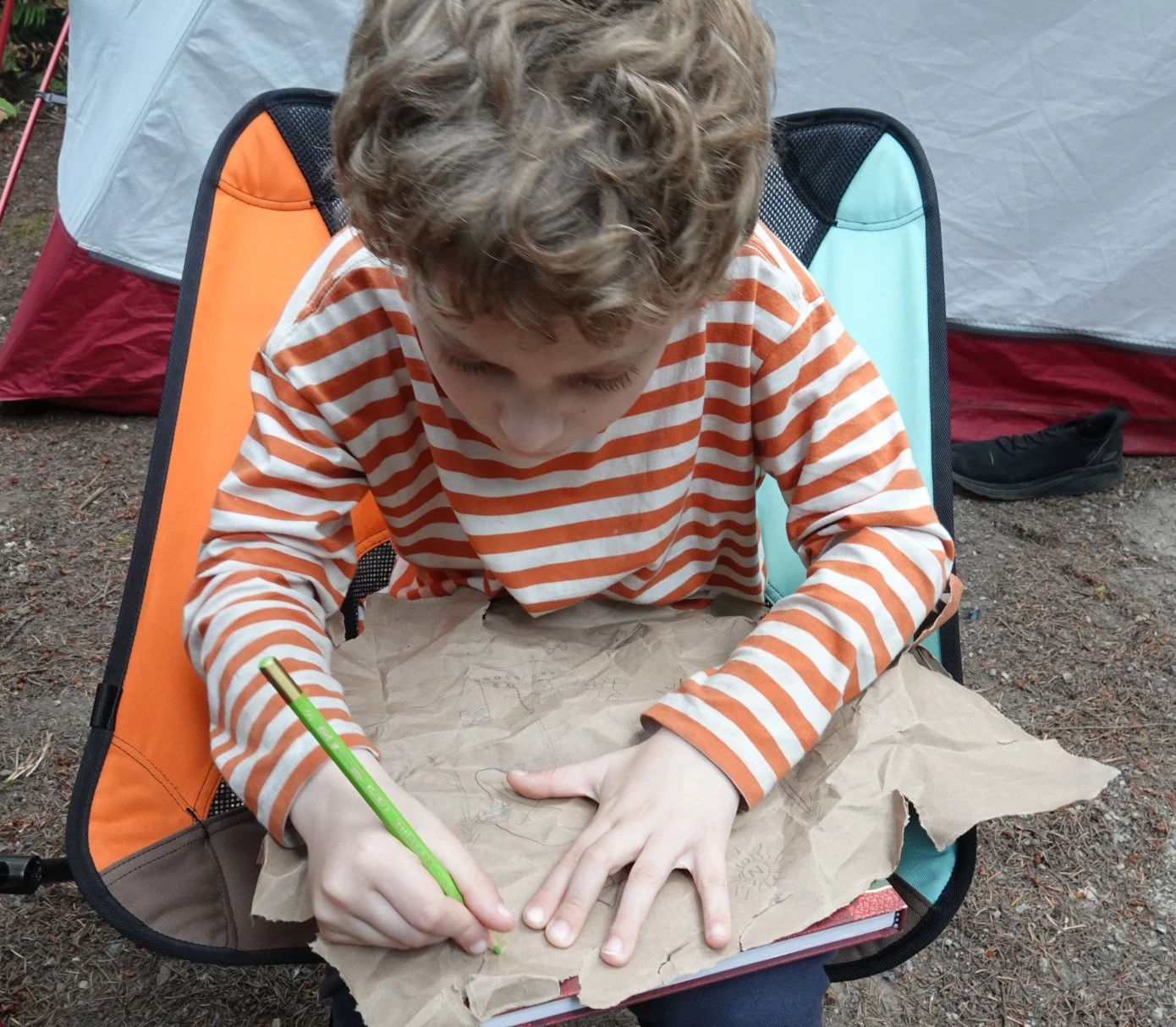
Leon working on treasure map. The map led to actual treasure which Leon and Rachel buried on the island and then left the map for some lucky person to find.
Leon wearing Dada’s sunglasses and Hat. Both kids enjoyed stealing my things, sometimes so they could impersonate me.
Alex holding green shore crab. The kids were excited to look at the shore crabs but not so excited about picking them up.
Rachel holding vanilla-leaf seeds. Rachel’s only previous visit to Hope Island was in May 2016, when she was pregnant with Maya.
Sidles family on Hope Island. We were the last of the campers to leave, but that’s because none of the other campers had thought to go feed the deer.
Remembering the unexpectedly favorable flood on the way to the island on Friday, I timed our departure on Sunday for the ebb. Sure enough, the currents carried us quickly and easily back to Boston Harbor. There have been plenty of trips where I guessed wrong about a current or was too slow to catch a favorable turn, but this time, everything worked perfectly.
Departing Hope Island. Maya absolutely refused to put any of the greasy sunscreen on her arms, but she avoided a sunburn by using her sweatshirt as a blanket.
Rachel and Leon kayaking past Squaxin Island. Squaxin Island is an undeveloped Indian reservation, closed to non-members.
Hope Island is a special place, and I’m glad the kids chose it. Between the deer, the games, and the relaxed time on the water, I can’t imagine a better three days than camping here with my family.
—Alex