Jaegers are gull- or tern-like seabirds who generally forage miles out to sea. They aren’t easy to spot from a kayak, except during their fall migration, when a small number of jaegers enter the inland waters, including the Strait of Georgia, Puget Sound, the San Juan Islands, and the Strait of Juan de Fuca.
I first stumbled across inshore jaegers in the San Juans by accident in September 2018. This year, I returned for a purposeful search.
Reasoning that jaegers would likely prefer the widest, deepest channels, I paddled across Guemes Channel, turned up Bellingham Channel along the east side of Cypress Island, camped overnight at Lawrence Point on Orcas Island with views north to the Strait of Georgia, then paddled back down Rosario Strait along the west side of Cypress Island.
Route map. Parking fees at Washington Park in Anacortes had increased from $11 per night to $11 per day, a seemingly minor bureaucratic adjustment that, in fact, doubled the cost of a one-night trip like this one.
Jaegers are kleptoparasitic predators, meaning they mainly eat prey that other seabirds have caught. A jaeger waits to pounce until another bird comes up with a fish. As soon as it does, the jaeger attacks relentlessly, pecking and striking the original hunter until it drops its catch, which the jaeger then steals. Even if the original hunter swallows the fish, the jaeger will keep attacking until the hunter regurgitates its prey.
During my September 2018 trip, I noticed that the jaegers in the San Juans almost exclusively targeted Bonaparte’s gulls, even when other gull species were present. To find jaegers again, I reasoned that I first needed to find Bonaparte’s gulls.
Paddling up Bellingham Channel along the east side of Cypress Island, I did not encounter a single Bonaparte’s gull. Usually, they are abundant in the San Juans during fall. This time of year, flocks of Bonaparte’s gulls seldom number fewer than a hundred birds and sometimes as many as a thousand. On this day, however, there were none. By the time I reached Pelican Beach at the north end of Cypress Island, I still hadn’t seen a single “Bony”—and no jaegers.
With sinking heart, I continued on across the open waters of Rosario Strait toward Lawrence Point. Lawrence Point was a twelve-and-a-half-mile paddle (20 km) from the launch beach, which is a long way to paddle not to see a jaeger. To make matters worse, a ten-knot headwind kicked up, blowing in opposition to the flood current. Whitecaps began washing across my deck, slowing my progress and making it hazardous to use my camera, which was not waterproof.
Just when I was starting to feel defeated, a jaeger swept past, low above the water! It was too far away to identify which of the three jaeger species it belonged to, but its sharply pointed wings, pale underparts, and especially its white wingtip flashes were unmistakable field marks.
The sight of a jaeger, even a distant one, renewed my spirits. A moment later, an even more auspicious sign: hundreds of small, white gulls, high over the strait, flocking tightly in the manner of blackbirds over a wheatfield. The much-desired Bonaparte’s gulls had arrived.
Kayaking out of Washington Park at dawn. This is the most popular starting point for kayaking trips in the San Juans, because it is the closest launch beach that does not require a ferry ride.
Kayaking north across Guemes Channel toward Bellingham Channel. Cypress Island is the closest landmass on the left, tall Lummi Island in the middle in the distance, and low Guemes Island on the right.
Sky full of Bonaparte’s gulls. Later in winter, these large flocks will disperse into smaller gatherings, but in early fall, you usually see either hundreds of Bonaparte’s or none at all.
Bonaparte’s gull, Rosario Strait. In breeding plumage, this species sports a striking, black hood over its head, but its wintertime appearance is more conventional for a gull, other than the unusual, pointy black bill.
Lawrence Point protrudes far enough into Rosario Strait to provide views for many miles to the north, south, and east. From here, it was easy to monitor the flocks of Bonaparte’s gulls that had eluded me while I was on the water.
It wasn’t long before the jaegers arrived. The first sign of their presence was an eruption of gulls flying up from the water’s surface. Bonaparte’s gulls can’t dive under water, so taking flight is their only means of escape from jaegers.
These jaegers were only too happy to meet them in the air. Each jaeger would single out a gull it suspected of carrying fish. The jaegers would swoop above and around the gulls, pecking relentlessly. Evasive actions were all but useless. The jaegers could maneuver more sharply than the gulls could, sometimes even rolling onto their backs like fighter jets to shorten their turning radius. One by one, each Bonaparte’s gull unfortunate enough to be singled out was forced to disgorge its meal. Without pausing for rest, the successful jaeger would move on to its next victim.
It wasn’t only jaegers attacking the Bonparte’s gulls. Hermann’s gulls got into the action, too. The Heermann’s weren’t as powerful in the air as the jaegers, but they made up for it by working in teams, ganging up on one Bony at a time.
Not all of the Heermann’s gulls attacked the Bonaparte’s. Most Heermann’s were content to forage for their own fish. It was only a handful of individuals who engaged in parasitism against the Bonies.
I wondered how each Heermann’s gull decided whether to become a parasite. If robbery was such a good idea, then why weren’t they all doing it? If a bad idea, then why were any doing it at all? Was it all just a matter of circumstance, or was there something particular in the soul of a gull to make it more or less likely to descend into brutality?
In the middle of the afternoon, the flocks of Bonaparte’s gulls dispersed to other waters. With nothing left to steal, the jaegers left, too. I lay down in the warm grass to take a nap, hoping the birds might return later in the day.
The sound of voices woke me up. I sat up and looked around to discover half a dozen whale-watching boats bobbing just offshore of Lawrence Point. Some were flying American flags, others Canadian. I couldn’t make out what the guides onboard the boats were saying, but something exciting was obviously afoot.
A moment later, four spouts sprayed into the air just a few hundred yards offshore. It was a family of killer whales, the T065B matriline, consisting of matriarch T065B “Chunk” (b. 1993) and her three sons, T065B1 “Birdsall” (b. 2011) T065B2 “Nettle” (b. 2019), and T065B3 “Rook” (b. 2023). Even though the whale-watchers were out on the water while I was ashore, it was I who enjoyed the best views of the whales—and all I’d done to find them was take a nap.
Lawrence Point seen from south. Each headland protects its own pocket beach of gravel, easy to land on at high tide but harder at low tide, when larger boulders are exposed.
Alex waiting for jaegers on Lawrence Point. Seabirds, marine mammals, and recreational fishermen in salmon trollers were all attracted to the swirling currents off Lawrence Point.
Parasitic jaeger off Lawrence Point. I saw three jaegers over the course of the afternoon, all of the parasitic jaeger species (Stercorarius parasiticus), as opposed to the pomarine or long-tailed jaeger species.
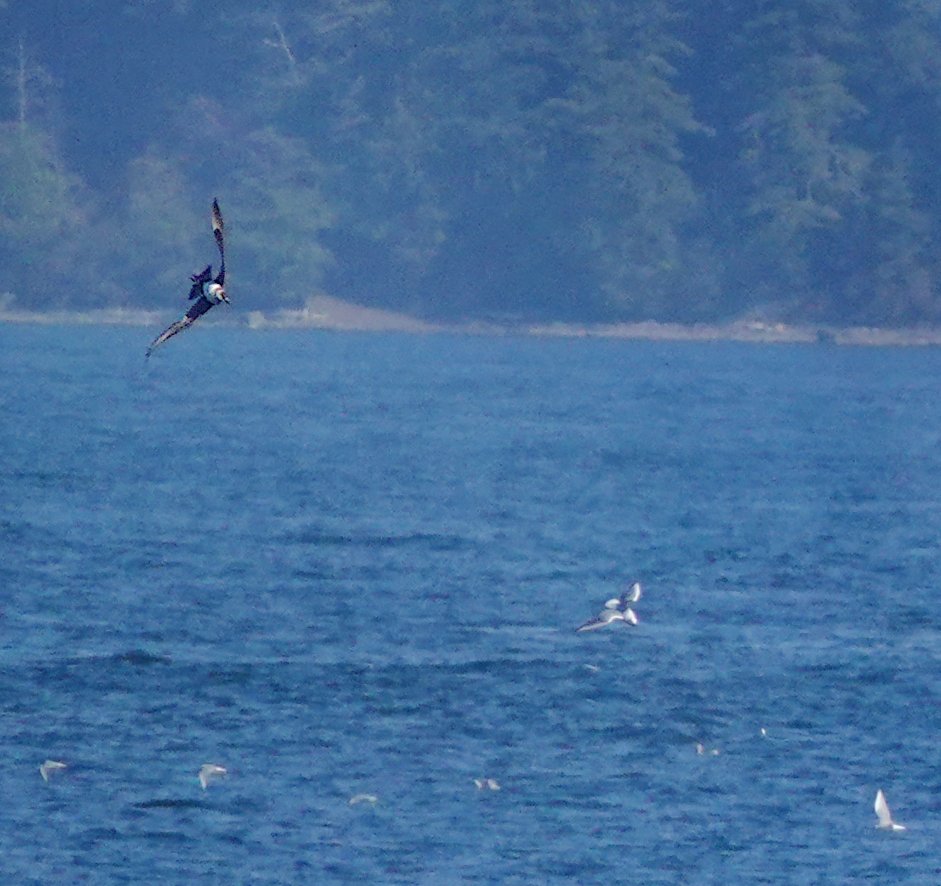
Parasitic jaeger twisting to pursue Bonaparte’s gull. The twin tail feathers streaming behind the jaeger are diagnostic of the genus, although not all individuals have the tail feathers.
Heermann’s gull pursuing Bonaparte’s gull, Lawrence Point. This is a juvenile Heermann’s gull, but it has already learned to steal.
Mother and calf killer whales off Lawrence Point. The matriarch female to the right, T065, is named “Chunk” for the notch carved out of the base of her dorsal fin.
Subadult male killer whale off Lawrence Point. At age fifteen, T065B1 “Birdsall” is already an enormous animal, but he still has some growing to do before he attains his full powers.
Killer whale spyhopping off Lawrence Point. The whale may have been watching the whale-watchers or it may have been scanning the shore for harbor seals and sea lions, its main prey in these waters.
Lawrence Point is on land leased to the state park system. Camping is not allowed on state park lands outside of designated campgrounds, of which there are none at Lawrence Point. However, the tidelands at Lawrence Point between the high-water and low-water marks belong to the Department of Natural Resources. On DNR land, camping is allowed unless specifically designated otherwise, according to WAC 332-52-300(14).
My plan was to camp on the beach below the high-tide line, taking advantage of the fact that during September, the highest tides occur during the daytime. At night, the tide stays low for longer than twelve hours at a stretch—plenty of time for a good night’s sleep.
It would have been a good plan, lawful and creative, but it came unravelled because I forgot my ground pad at home. After an internal debate, I decided I could not face sleeping on the bare, wet gravel below the high-tide line. With a little bit of embarrassment, I carried my sleeping bag out to the point and slept out on the grass under the stars.
All night, I could hear common murres foraging on the water in Rosario Strait. They croaked to one another to maintain contact in the moonlight. It’s a sound I associate with camping on the inland waters during fall.
A lone mosquito began buzzing in my ear. It seemed hopeless to try to kill it, so I just lay still, expecting it to bite me. A minute later, a bat flew low overhead, and after that, I didn’t hear the mosquito anymore. I can’t be sure it was the bat who saved me from the mosquito, but one way or another, I didn’t receive any bug bites of any kind all night.
Two adult male Steller sea lions woke me up before dawn. They were huffing loudly below the bluff where I was sleeping. They glared at me when I sat up, and bared their fangs. These overconfident tough guys were lucky they hadn’t been there the previous afternoon when the family of killer whales swam past.
The morning flood up Rosario Strait was too strong to fight in a kayak. I laid out my things in the grass so the sun could dry out the condensation while I went for a walk through the woods all the way to the county road system. After lunch, I caught the ebb down Rosario Strait back to Anacortes, stopping along the way on Strawberry Island to revisit my favorite campsite in Washington.
Steller sea lion at dawn off Lawrence Point. Their breaths sounded nearly as loud as those of the killer whales, although they were also closer to me than the whales had been.
California and short-billed gulls in a feeding frenzy to catch Pacific herring. I’m not sure why the jaegers never attacked either of these species of gull, unless it was due to these gulls’ larger size compared to the Bonaparte’s.
Common murre, Rosario Strait. Many of the murres, including this individual, were in transition from breeding plumage to winter plumage.
Double-crested cormorants, Strawberry Bay. Very unusually for the San Juans, this was the only cormorant species I saw.
Kayaking toward Strawberry Island from the north. There was a rowboater on the island when I arrived, the first other person I had met on Strawberry Island in many years.
Kayaking south down Rosario Strait. By the time I reached Guemes Channel, the ebb had moderated, making for an easy crossing between Cypress Island and Washington Park.
Kayaking south around Reef Point, Cypress Island. At low tide, the reef for which this feature is named extends hundreds of yards out to sea, but at high tide you can practically hug the cliff all the way around.
Back at Washington Park, the local elementary school parent-teacher association was hosting their back-to-school cookout. Irresistible smells wafted from their grill the whole time I was loading my kayak onto my car.
As soon as I was all packed up, I put on a clean shirt and a pleasant smile and worked my way slowly and patiently through the crowd of parents, nodding politely and chuckling knowingly as they nattered on about upcoming board elections and school event calendars. In fact, I had no idea who any of these people were or what they were talking about.
At last I reached their food tables. Quick as a flash, I loaded up a hot dog and a gigantic plate of macaroni and cheese and made my getaway back to my car before anyone could ask questions. They thought I was another Bonaparte’s gull but really I was a jaeger.
—Alex Sidles