Leon, age six, picked Wingehaven as the destination for a weekend camping trip with me—just the two of us. Wingehaven was the site of Leon’s first-ever camping trip when he was two years old, and he has loved returning here ever since.
Route map. Free overnight parking is just up the hill from the launch ramp.
Leon couldn’t remember the name of Wingehaven. He described it as “the island with the chess pieces.”
His description made sense to me. Before it became a public park, Wingehaven was a private estate. In 1914, the former owners built a concrete seawall with a balustrade running along its top. Most of the balusters were destroyed by vandals after the property became a park, but a few have survived down to the present day. With their short, tapered bodies and small heads, the surviving balusters look like pawns from a chess set. Leon suggested that we could “play chess on top of the chess pieces.”
Leon in the library at Vashon Island ferry dock. Leon wasn’t interested in the books, but he found the building irresistible.
Leon on launch beach beside Vashon Island ferry terminal. The narrow boat ramp descending from the dock to the beach is unusable by vehicles but fine for hand-carried kayaks.
Leon ascending seawall stairway to Wingehaven. Leon would sometimes scurry up the steep concrete ramp instead of the stairs, but I never had the courage to try it myself.
“Chess pieces” atop seawall at Wingehaven. By American standards, these fixtures from 1914 practically qualify as ancient ruins.
Our chessboard was too wide to fit on top of the balusters, so we played on the picnic table instead. Grandmaster Leon achieved a brilliancy, deploying several theoretical novelties, including an endlessly respawning queen, a chess clock that reset whenever it reached zero, and a king that was somehow capable of checkmating the opposing king without placing itself in check.
Leon came up with all sorts of other games besides chess. His favorite was throwing pebbles against the seawall or beach boulders. Some of the pebbles were so fragile they would burst into a million tiny pieces like a grenade.
As the tide came up, we began hopping from boulder to boulder to keep our feet dry. Leon spotted a caterpillar on top of one of the boulders. The rising tide had already cut off the caterpillar’s retreat to the beach. Leon agreed that we should move the caterpillar to dry land.
I tried to nudge the caterpillar onto a pebble, but I accidentally knocked it into the salt water. Leon still wanted to save the caterpillar, so I scooped it out of the water and tossed it onto the sand. I thought it was probably dead already, but Leon watched it until it started moving again. Leon put a dry pebble next to it, and the caterpillar laboriously inched its way on top. There it stopped moving, although it still seemed somehow to be clinging to the pebble.
The caterpillar’s stillness seemed like a bad sign to me, but I kept my doubts to myself. I suggested to Leon that the caterpillar had climbed the pebble to dry out its “fur”—really its bristles—and probably it would start moving again once its fur had a chance to dry.
Leon liked the idea of the drying caterpillar, but he pointed out the rising tide would soon submerge the caterpillar again, even in its new location. We picked up the pebble, careful not to dislodge the caterpillar, and carried it above the high-tide line at the top of the beach, next to a steep, vegetated slope.
Leon wanted to go back and check on Catty the Caterpillar throughout the afternoon and evening, but the same rising tide that had started the whole trouble soon reached the bottom of the stairs leading down the seawall, blocking our access to the beach and preventing us from revisiting the scene of the rescue.
When we finally returned the next morning, the pebble was where we had left it, surrounded by dry sand above the high-tide line, but Catty the Caterpillar had disappeared. The most likely explanation, so I told Leon, was that Catty had indeed gone into the forest after his fur had dried.
Alex and Leon playing chess at Wingehaven. Leon has been unstoppable at kayak-chess since he was three years old.
Leon chewing a blackberry. Even in late September, most of the berries were not ripe enough to enjoy.
Leon hurling pebble at seawall. Some of the sturdier pebbles required two or three shots before they would explode.
Leon on stairs at high tide. North and south of Wingehaven, the high tide did not submerge the entire beach, but at Wingehaven itself, the water came all the way to the base of the stairs, trapping us in the park and preventing us from revisiting Catty.
Our return to the ferry terminal was a difficult paddle, in spite of the short distance. The wind was blowing seventeen knots, according to the nearby weather stations at Alki Point and West Point. Two-foot chop hit us on the beam, slopping water into the boat and soaking our clothes. Leon was so frightened he hid his face in the hood of his jacket and whimpered.
Because of the northerly wind, the waves were breaking directly on the landing beach. Two-foot surf is plenty high enough to capsize a kayak, especially a broad-beamed two-person folding kayak, so we had to be cautious. I paddled us under the ferry dock so the pilings would break up the waves. On the far side of the dock, I paddled backwards through the surf zone to avoid being broached by a breaker striking us from behind.
Leon was shivering in his wet clothes. I sat him on a driftwood log in the sun and changed him into dry clothes so he could warm up while I carried the boat and all our things up the beach. To make up for the unpleasant paddle, I bought him a plate of tater tots on the ferry ride back to Seattle.

Mount Rainier early in the morning, seen from Wingehaven. For a brief period on Sunday afternoon, we were also able to see Mount Baker.
Short-billed gull, west of Dolphin Point, Vashon Island. This was the most numerous bird species of the trip.
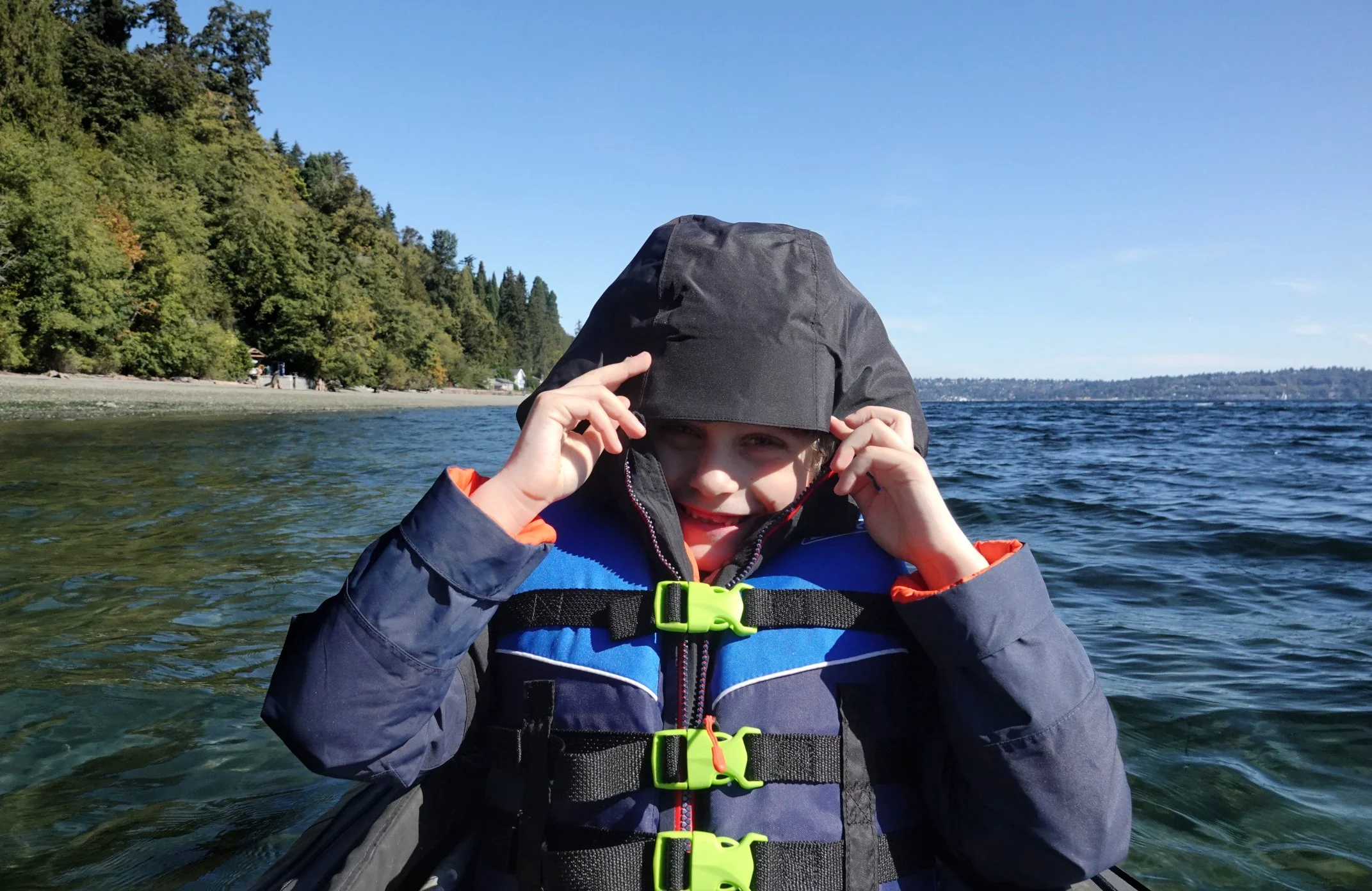
Leon in kayak, riding northward toward Dolphin Point. Around the far side of Dolphin Point, the chop increased to two feet, soaking both of us and frightening Leon.
Even despite the tater tots, Leon told me this paddle was worse than the time I got us stuck in quicksand, an incident which had previously defined the lowest point of Leon’s kayaking experiences.
When we got home and Leon told his stories to the rest of the family, he did not spare me his criticism for the cold, choppy return paddle. At the same time, he was bursting with excitement to recount the stories of the exploding pebbles, rock-hopping boulders, and the heroic rescue of Catty the Caterpillar.
We didn’t manage to get a photograph of Catty before his fur dried out and he disappeared back into the forest. Instead, to help him remember Catty forever, Leon brought home one of the shards of pebble we had shattered, so he could paint the rock with Catty’s name as well as his own.
Thinking about the caterpillar, and the painted rock, and my growing boy fills me with an ache that I had never imagined when I was young.
—Alex Sidles
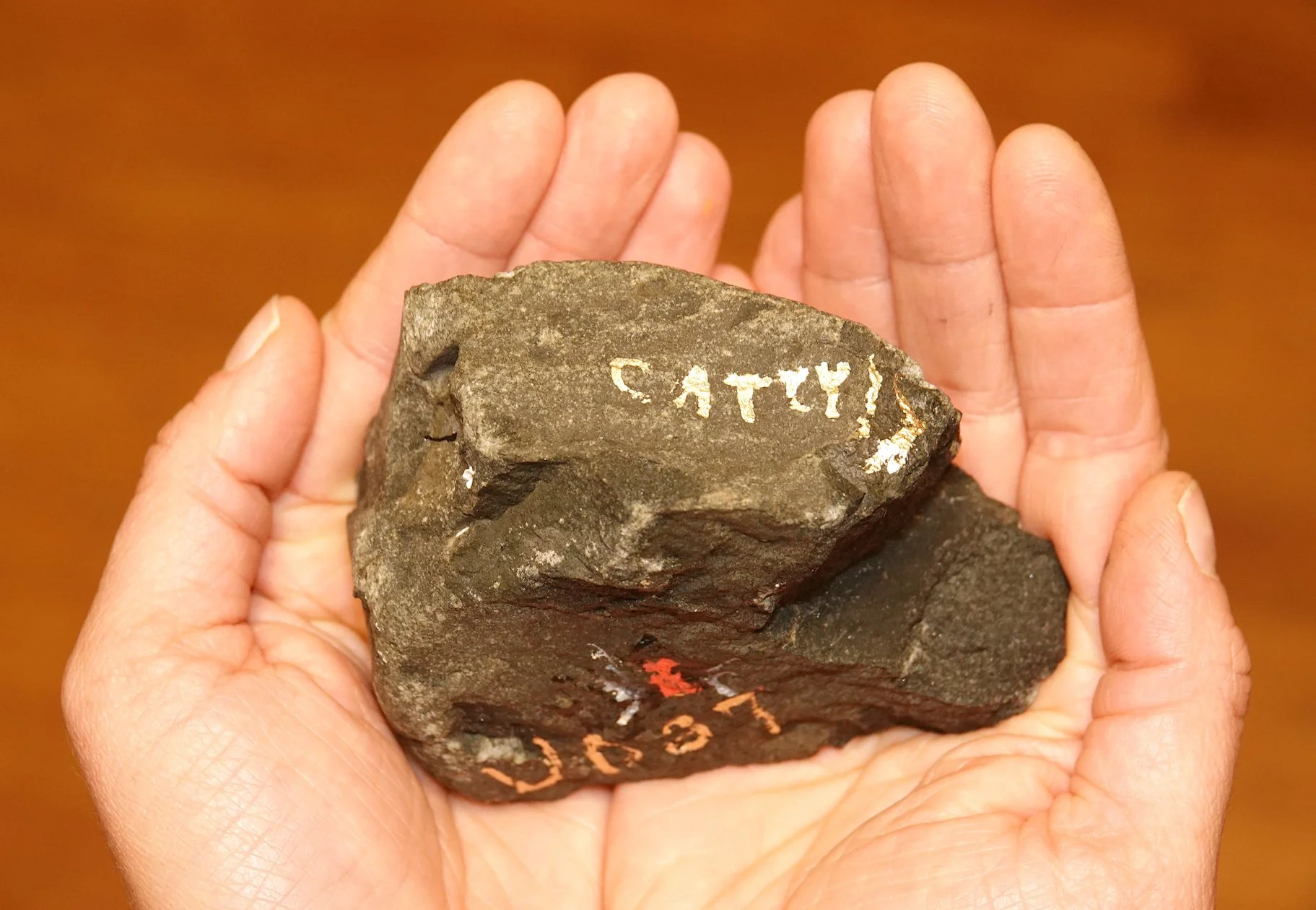
Rachel holding Catty’s pebble. In addition to painting his own name, Catty's name, and a small portrait of Catty, Leon also dictated the following message for Rachel to paint on the other side of the pebble: “This rock is to remind us of Catty the Caterpillar, a tent caterpillar we found at Wingehaven.”