The ancient murrelet is a small seabird of the alcid family. It winters up and down the west coast, even as far south as Mexico, and is a common sight on Washington waters between October and March. The ancient murrelet breeds on remote, vegetated islands in the Bering Sea, Gulf of Alaska, and as far south as Haida Gwaii.
South of Haida Gwaii, there has only been one confirmed breeding record for the ancient murrelet: from Carroll Island, Washington, in 1924. Strangely, however, in recent decades, ancient murrelets have been spotted in increasing numbers in Washington waters during the breeding season. In some cases, these summer-season murrelets have been accompanied by newly hatched juveniles. Could ancient murrelets secretly be breeding in Washington?
Scientists are skeptical. Just because a juvenile murrelet has been spotted in Washington doesn’t mean it hatched here. It could have hatched in Haida Gwaii and swum south in preparation for the winter. Even if a juvenile is present in Washington early in the season, say the skeptics, it could simply mean that this chick happened to hatch unusually early in Haida Gwaii and then decided to swim south unusually rapidly. The skeptics won’t be convinced until they see an ancient murrelet nest in Washington.
It’s not easy to find an ancient murrelet nest. Not only do ancient murrelets nest exclusively on remote, inaccessible islands, they also build their nests deep underground in burrows. The burrows are not only hard to spot, they are also camouflaged among hundreds, and sometimes thousands or even tens of thousands, of other burrows excavated by other seabird species, such as Cassin’s auklets, rhinoceros auklets, Leach’s and fork-tailed storm-petrels, tufted puffins, and so forth. From the outside, it’s impossible to tell which species is inside which burrow. Even worse, ancient murrelets only enter or exit their burrows in the middle of the night, so it is not possible to locate the nest simply by following the bird.
There’s no easy solution to confirming or refuting the possibility of ancient murrelet breeding in Washington. One creative approach has been to deploy acoustic recorders on potential nesting islands. The recording units sit on the islands for months on end, capturing ambient sounds, including at night, when ancient murrelets attend their burrows. Researchers train computer algorithms to search the recordings’ acoustic histograms for the calls of the ancient murrelet—thus sparing the researchers the need to sit through thousands of hours of mind-numbing audio in hopes of possibly hearing an occasional, faint call from an ancient murrelet.
Even an audio recording of an ancient murrelet on a breeding island during breeding season wouldn’t satisfy the skeptics. Skeptics want to see eggs in burrows. The main purpose of the audio recordings, then, is to suggest possible locations for nests. The recordings themselves are not conclusive evidence of breeding.
To add to our growing knowledge about ancient murrelet breeding on Washington, I paid a visit to the Bodelteh Islands off Cape Alava on the Olympic coast. The Bodeltehs are one of the locations where ancient murrelets have been spotted swimming on the water during breeding season and recorded calling on the island at night. My plan was to paddle offshore of the islands at night in my kayak, in hopes of spotting an ancient murrelet flying onto or off of the island.
The beaches on Cape Alava nearest to the Bodeltehs are too rocky to land a kayak. I set out instead for the closest sandy beach, some two and a half miles (4 km) east of the Bodeltehs, at the mouth of the Ozette River. Over the three-day Memorial Day weekend, I planned to use the Ozette River as a base camp for nocturnal forays out to the ocean waters off the Bodelteh Islands to look for ancient murrelets by moonlight.
Route map. The other possible access point would have been La Push, but that would have required about half again the paddling distance as from Hobuck.
My plan ran into complications right away. On the morning of the first day, the ocean swell was running eight feet (2.4 m) high, and wind was blowing ten knots. It was no trouble to launch from the protected waters at Hobuck Beach, where the shape of the beach reduced the height of the waves. Surf was no more than two feet at the north end of the beach. Out on the waters of Makah Bay, however, I encountered the swells’ full strength, plus additional chop from the wind. Farther south, waves reflecting off the cliffs at Portage Head and Point of the Arches added to the sloppiness. Fields of boomers in the vicinity of the points forced me a mile (1.6 km) offshore for fear of being ambushed by waves breaking over submerged rocks.
Conditions were manageable for kayaking but not for birding. I couldn’t take my hands off the paddle for longer than a few seconds at a time. Using binoculars was out of the question. The only birds I could recognize were those that happened to fly past my kayak close enough to identify with the naked eye. It began to dawn on me that doing this at night, when these same waves would loom suddenly out of the darkness, would be even less productive for birding than doing it by day.
Worse still, the forecast called for a low-pressure system to hit later that weekend. The system would bring sustained winds over thirty knots, plus swells up to eighteen feet (5.7 m). Thirty knots is too much wind for kayaking even on the inland waters, let alone the open ocean, while eighteen-foot swells would leave me stranded on the beach for days, unable to punch out through such giant surf.
I paddled south, fuming. Not only was the nocturnal portion of the trip impossible, I would also have to leave the beach early to avoid being stranded by the gale. I debated turning the kayak around and going home. The whole point of paddling to the Ozette River was to use it as a staging area to look for ancient murrelets. If there was to be no murrelet search, then why even continue?
Eight-foot swell in Makah Bay. The height of the swells made it difficult to spot the places where waves were breaking over submerged rocks, some of which lay miles offshore.
Kayaking south toward Cape Alava. Conditions on the water improved south of Portage Head, but I still had to stay far offshore.
From left to right: Cape Alava, Tskawahyah Island, Ozette Island, and the three Bodelteh Islands. Cape Alava is often called the westernmost point in the continental United States, but there is the awkward fact that Tskawahyah Island, which lies west of Cape Alava, adjoins the mainland at low tide.
Looking north toward Father and Son Rocks, with Point Will and Point of the Arches in the background. Boomers and reflecting waves kept me far offshore.
The murrelets themselves came to my rescue. Ahead on the water, a few miles north of the Bodelteh Islands, I spotted three little silhouettes showing the distinctive, forward-craning necks of murrelets. I assumed at first these were marbled murrelets, a species encountered year-round in these waters, which I had already been seeing all morning. Only once I drew near enough to see the birds’ color did I realize this was a flock of three ancient murrelets.
Three ancient murrelets! I had thought I’d be lucky to see even one. My camera was already stowed in preparation for the surf landing at the Ozette River. I hastily dug it out and, balancing the boat with my knees in the choppy conditions, began photographing the murrelets. Ordinarily, I don’t risk taking bird photos in rough conditions, but this was a matter of science. Sapere aude!
A few hundred yards farther along, I bumped into a second flock. This time it was four ancient murrelets. Out came the camera again, and another few minutes of precarious balancing in big seas. These summer-season murrelets were so rare, I thought, I had better document them all, no matter the risk.
Then came two more murrelets, this time flying. Then two more. All told, I counted at least seventeen ancient murrelets across two days of kayaking. These ancient murrelets weren’t rare. They were abundant. I stopped jeopardizing my life every time I saw one and confined my photography to periods of calm conditions only.
Still a few miles north of the Bodelteh Islands, another seabird species, even more spectacular, awaited. I was slogging through bumpy conditions when a trio of small shearwaters swept past. A shearwater flyby isn’t an unusual experience on the coast, as sooty shearwaters summer here in vast numbers and can often be found just a mile or two offshore.
These were not sooty shearwaters. These had white underparts and white “saddlebags” extending up the sides of their rumps, reminiscent of violet-green swallows. They were Manx shearwaters!
The Manx shearwater is a bird of the Atlantic Ocean, not the Pacific. Even in the Atlantic, the Manx shearwater was formerly found only in the eastern half of the ocean, on the European side, not the North American side. Beginning in the 1950s, it slowly expanded its range to the western Atlantic. It was first documented breeding in Martha’s Vineyard in 1973.
By 1990, it had expanded its range still further. That year, Manx shearwaters began to be seen in small numbers in Washington’s waters for the first time. At first, everyone assumed these were stray birds from the Atlantic. Perhaps they had rounded Cape Horn and mistakenly flown up the wrong coast, stranding them in the Pacific Ocean instead of the Atlantic.
Each year, the numbers of Manx shearwaters seen here in the Pacific crept higher and higher. It soon became apparent that the “Atlantic strays” hypothesis was unlikely—not with more and more shearwaters appearing each year. By the 2020s, it was no longer considered remarkable to see a Manx shearwater during a pelagic birding trip in Washington. These birds were becoming almost common, even though this is the wrong ocean. The only explanation for the steadily increasing abundance is that Manx shearwaters must have started breeding somewhere here in the eastern Pacific.
No one has yet identified the Manx shearwaters’ Pacific Ocean breeding colony. It’s likely to be on one of the existing major seabird nesting islands: Destruction Island in Washington, say, or perhaps Triangle Island in BC. But who knows? It could easily be the Bodelteh Islands. The fact that I encountered not one but three, travelling together, is highly suggestive.
First flock of ancient murrelets north of Bodelteh Islands. I usually only see this species in its winter plumage, so it was a treat to see the more elaborate breeding plumage.
Second flock of ancient murrelets off Bodelteh Islands. I had hoped to document a downy, flightless chick, or at least a juvenile bird, but these appear to be adults.
Manx shearwater off Bodelteh Islands, 23 May 2026. The flock of three swept past me before I could reach my camera, but one of them broke off and swooped back around for a photo.
Between the ancient murrelets and the Manx shearwaters, my spirits were fully restored. I had come to find evidence that rare seabirds might be breeding in secret on the Bodelteh Islands, and in light of the numbers I’d encountered, I had found it. No need to brave the swells and wind at night. Daytime birding had succeeded beyond my biggest expectations. I resolved to camp at the Ozette River for one night just so I could visit the islands one more time on my way home the next day.
Now it was just a matter of surviving the surf landing at the Ozette River. I had hoped that Cape Alava and the offshore islands, including the Bodeltehs, might afford protection against the full strength of the swells. Approaching from the ocean side, it did look as if the surf south of the river mouth might be pretty low. I waited for what seemed like a lull and raced toward shore.
It was a trap. The landing on the south side of the river passed through a field of boulders three hundred meters wide. The backs of the waves had concealed the rocks until too late. A wave broke over one of the rocks at an awkward angle and capsized me into a mess of surf. I was already short of breath before I went over, so I did not even attempt a roll. I immediately popped out of the cockpit and swam for it through the breakers.
I was none too eager to be surfed onto a sharp rock, but I was even more worried about my boat. Laden with gear and now carrying hundreds of pounds of seawater in the cockpit, the boat could be destroyed if it were to slam into a rock. I body-surfed in pursuit of the boat and caught up with it just in time to shove it to the side of a large, barnacle-encrusted rock. The next wave shoved me into that same rock, but I managed to strike feet-first, half swimming, half crab-walking over the top of the boulder and into the foam on the other side.
The boat kept veering toward rocks as if it had a death wish. Each time, I would try to reach the rock first so I could deflect the boat, hoping my hard-soled booties and foam lifejacket would provide enough armor to protect me from the next wave’s impact against the rock. The boat weighed far more than I did, so it wasn’t easy to keep swimming it out of harm’s way. At last, the boat and I washed ashore together on the sandy, northern bank of the Ozette River, where I should have landed all along instead of the rocky, southern bank. The surf may have looked a little bigger here on the northern side of the river, but it was breaking cleanly over sand instead of sloppily over rocks.
The cockpit was so full of water I could not even tilt the boat onto its side to dump it. I had to pump out some of the water by hand to lighten the boat enough that I could roll it over to dump the rest.
Alex on beach, Ozette River. I lost a bottle of gatorade during the capsize, but a hiker on the beach found it and returned it to me under the correct assumption that it must belong to that kayaker who capsized south of the river.
Tent on beach, north bank Ozette River. The high tide crept within thirty feet (9 m) of the tent, not close enough to worry me.
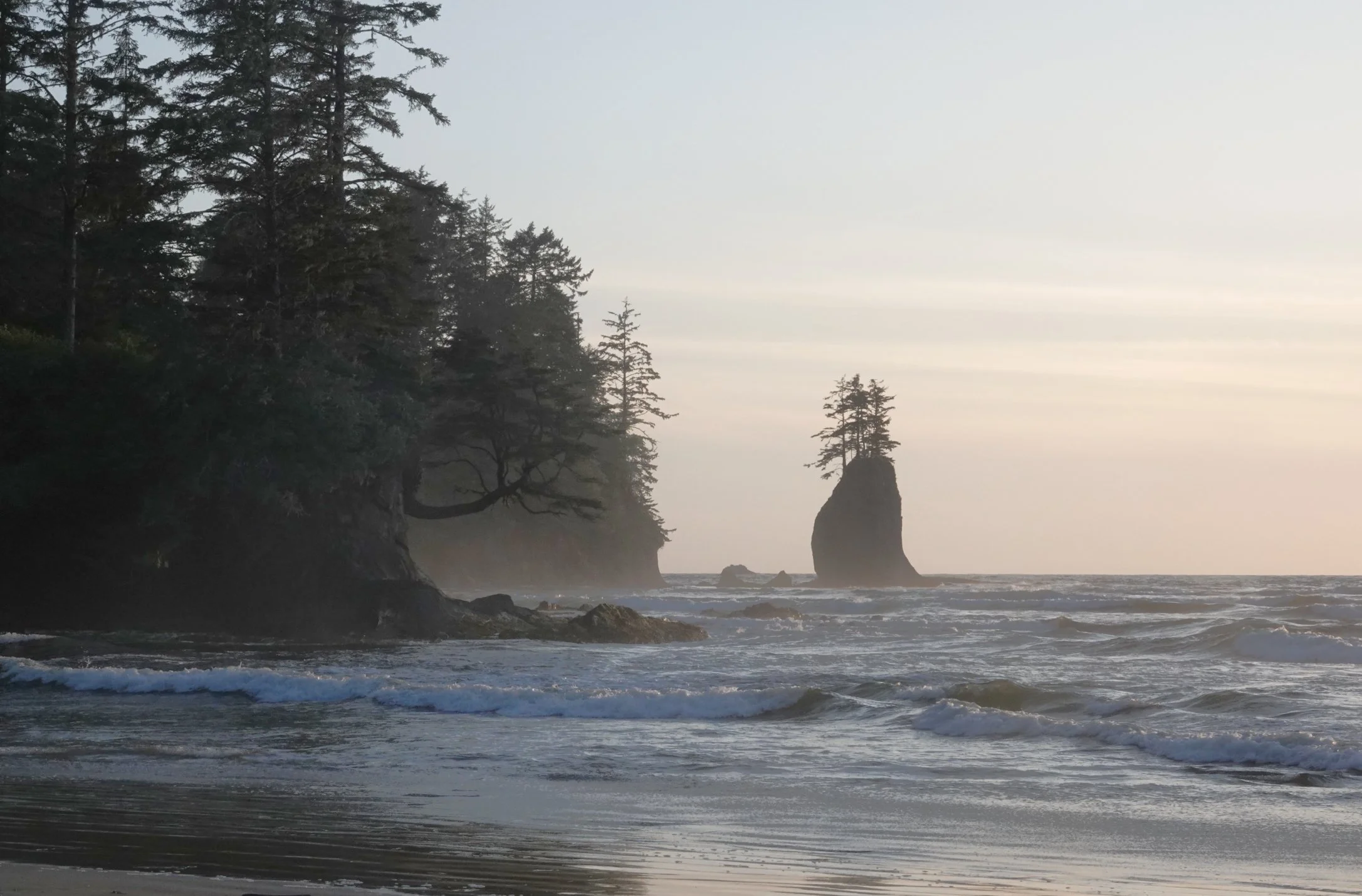
Southward view from north bank of Ozette River. A dozen or so overnight hikers camped in the forest or on the beach, but I was the only kayaker.
Brown pelicans at sunset. Seen at a distance, from a wilderness beach, these giant creatures resemble pterodactyls more than they do modern birds.
The beach was such a welcome refuge it would have made a worthy kayaking destination even in the absence of the seabirds. There are sandy beaches up and down the Olympic coast, but most of them are fully exposed to the ocean swells, which causes large surf. Here at the Ozette River, the offshore islands and the curvature of Cape Alava afford protection. On the first day of this trip, for example, eight-foot swells on the ocean were reduced to four-foot surf on the beach. On the second day, six-foot swells were reduced to three-foot surf.
I had originally planned to use one of the days of the three-day weekend to hike south around Cape Alava to look for the “wedding rock” petroglyph collection. The oncoming low-pressure system forced me to change my plans. Thirty-knot winds would make kayaking an impossibility, and even after the winds died, the swell height was forecast to remain in the double digits for days after the system passed, too high for a surf launch. A three-day visit risked turning into a five-day residence. With regret, I would have to depart the next morning to avoid being stranded.
Father and Son Rocks seen from Ozette River. Three-foot surf is big enough to seem exciting but not so big as to seem scary.
Ozette River. This river is home to an endangered run of sockeye salmon.
Ozette River delta. A slow but steady parade of backpackers passed along the beach all weekend, removing their boots to wade across the river.
Spotted sandpiper, Ozette River. “Spotties” are common throughout the summer in Washington, and a small number of individuals also spend the winter.
On the second day, the swell was down to six feet (1.8 m) and the wind was calm. These were much better conditions for birding, although I was still glad I hadn’t tried going out to the Bodelteh Islands at night.
Great flocks of seabirds were roosting on the water in the lee of the islands when I arrived in the late morning. Rhinoceros auklets and common murres were the most abundant. There were also dozens of loons, both common and Pacific. Surf scoters and white-winged scoters were present in small numbers. There were even a few more ancient murrelets, the species which had lured me here in the first place.
The handsomest species was the tufted puffin. Puffins are in a state of steep decline in Washington, but they can still be found reliably in the vicinity of their nesting islands on the Olympic coast. The Bodeltehs are not a major colony site for puffins, but the most recent count (2017) identified eleven puffins here. I found a single puffin off the Bodeltehs and later another dozen or so off other islands farther north.
Three parasitic jaegers put in an appearance about seven miles north of the Bodeltehs. These are arctic-nesting seabirds whose main source of food is theft of fish from other seabirds. The jaegers I saw were not attacking other birds, but they did swoop past my kayak as if checking whether I might have any fish for them to steal.
Brown pelicans on rock off Cape Alava. Brown pelicans do not breed in Washington, so these are likely individuals who have dispersed northward after the end of their breeding season.
Red-necked phalarope off Cape Alava. These delicate-looking shorebirds are smaller than robins, yet they spend months at a time on the open ocean.
Tufted puffin off Bodelteh Islands. Puffins are inquisitive birds and will often fly out of their way to investigate a passing kayaker.
Rhinoceros auklet off Bodelteh Islands. Almost the entire North American population of rhinoceros auklets breeds on just eight islands between Washington, British Columbia, and Alaska.
Common murre off Bodelteh Islands. This is the largest of the regularly occurring alcids in Washington.
Leucistic common murre off Bodelteh Islands. This individual has a genetic mutation that has reduced the melanin content in its bill, feet, and feathers.
Ancient murrelet off Point of the Arches. Hopefully, their breeding colony—if it does exist—will expand until these birds are as abundant in summer as they are in winter.
One surf scoter, two common murres, and three white-winged scoters off Bodelteh Islands. Common murres are so gregarious they often flock with totally unrelated species such as these scoters.
When conditions had been rough, I had wanted to give up and go home. Now that conditions were calm, I wanted to stay forever. The sun swung around to the western half of the sky and began its descent toward the horizon. Soon night would come, and with it the winds and swells of the approaching low-pressure system. I am not a murrelet. I am not a phalarope. I might be larger and stronger than these seabirds, but I am far more vulnerable. It was time to head back to my car.
Two species of marine mammal met me upon my arrival in Makah Bay: sea otters and surfers. The sea otters were in a loose herd some half a dozen strong bobbing amid the chop a mile or so offshore. My passage disturbed their rest. They bobbed in the water, glaring at me as if to urge me to depart more rapidly.
The surfers were even less happy to see me than the sea otters had been. Kayakers can pose a hazard to surfers. If our boats capsize in the breakers and fill with water, they become deadly, unguided missiles weighing hundreds of pounds. I swung wide around the surfers toward the north end of Hobuck. The surfers were all clustered along the stretch of beach with the largest waves, whereas I wanted the stretch with the smallest waves.
Kayaking north toward Cape Flattery. Vancouver Island was visible in the far distance whenever the clouds and haze weren’t too thick.
Some of the arches at Point of the Arches. It would be possible to shoot the arches if the tide were higher and the swell lower.
Sea caves at Portage Head. These caves would be another place to explore during a higher tide and lower swell.
Sea otter in Makah Bay. Besides the sea otters, the other marine mammals of the trip were a harbor seal, four harbor porpoises, a small herd of California and Steller sea lions, and a single gray whale.
Sea kayaking and birdwatching are both exercises in the absurd. A kayak on the ocean is so slow and so vulnerable, and such an enormous amount of work to paddle anywhere, that there is no rational justification. Similarly, the seabird species off the Bodelteh Islands could all be found elsewhere with far less effort.
Even though it doesn’t make sense, I prefer to face the ocean and the seabirds in a smaller, more personal way, and visit according to their terms rather than mine. I still don’t know whether ancient murrelets or Manx shearwaters breed on the Bodelteh Islands, but I do know why they took to the sea in the first place.
—Alex Sidles