Ever since I first learned of them in 2019, I’ve gone out to look for gray whales each spring in Possession Sound. Possession Sound is the body of water between Everett and Whidbey Island. It is ideal habitat for gray whales: a shallow, sandy-bottomed eastern half where the whales can dig in the sediment for shrimp, and a deep western half where the whales can rest without fear of stranding at low tide.
Most gray whales in the eastern Pacific migrate along the outer coast, but a population of a dozen or so-called “sounders” have become so fond of the foraging in Possession Sound that they stop here all spring. Throughout April and May, they are easily and reliably found in the vicinity of Hat Island or in the Snohomish River delta.
This year, I wanted to show the gray whales to my wife, Rachel, and our two kids, Maya and Leon. We waited for a day of calm wind and launched from the Everett marina.
Route map. During the ebb, a current inside Jetty Island sets south at a speed of one or two knots.
The trip nearly ended before it could begin. We had already unloaded the boats, moved the car to the day-use parking lot, and donned our rubber boots when we discovered that I had forgotten the kids’ life jackets at home. Going back to retrieve them would add two hours to an already-long day.
I was stomping off angrily in the direction of the parking lot when I remembered that some marinas operate a life jacket loaner program. At that very moment, a Port of Everett staff member pulled up in a truck. She pointed me to the marina’s locker full of life jackets in all different sizes. The trip was saved! The one piece of equipment we needed was the one piece they hand out for free.
To reach the deep waters of Possession Sound, we had to round Jetty Island. It look longer than expected, owing to an adverse current in the channel between the island and the marina. The kids were already clamoring for a break by the time we reached the north end of the island. We had been planning to stop for lunch on the sandy beaches of Jetty Island anyway, so we pulled over early to give the kids a break.
While the kids were eating and playing on the beach, I walked around to the outside of the island to scout for gray whales. Gray whale spouts are visible to the naked eye at a distance of about three miles (5 km), but Possession Sound is more than six miles across, so binoculars were a must.
It took awhile to spot them, but sure enough, there they were: multiple spouts in the whales’ favorite hangout area southeast of Hat Island in the middle of the sound. I hurried back to Rachel and the kids and we climbed back into the boats.
Kids rafting up to Rachel’s kayak. The three of us were pretty tightly packed in our one kayak, so Rachel carried most of our supplies in her single and passed us whatever we needed.
Rachel paddling off Everett marina in Port Gardner Bay. Harbor seals began following us in this channel and escorted us for the remainder of the trip.
Rachel and Maya playing with bamboo on Jetty Island. There are miles of sandy beaches on Jetty Island, and we had them all to ourselves this morning.
Maya looking through bamboo, Jetty Island. In the kids’ hands, the bamboo could become a telescope, a set of claws, a shovel, a paddle, or a sword.
View of Hat Island from Snohomish River delta. The gray whales are most commonly found off the southeast corner of the island (left side in this photo).
Although I’ve done this trip many times before, Possession Sound can still surprise me. One of the tricky factors here is the mudflat off the Snohomish River delta at the north end of Jetty Island. At low tide, the bay dries to a distance of at least a mile and a half offshore of the island. There are channels through the mudflat, but they’re impossible to discern from the cockpit of a kayak. You don’t know what’s channel versus what’s drying mudflat until the water drops and strands you hundreds of meters from shore.
I thought we had swung wide enough around Jetty Island to avoid the shallowest of the flats, but I was wrong. As the tide continued to drop, the water beneath our boats became shallower and shallower until my boat, the heavier of the two, glided to a halt, aground in the mud.
There wasn’t a moment to lose. A grounding on a falling tide will only get worse with each passing minute. On the Nisqually River delta, where there are similar mudflats as the Snohomish, I’ve gotten stranded so badly there was nothing to do but climb out of the cockpit, sit on the deck, and eat lunch while waiting for the tide to return. Here off Jetty Island, the tide would not return to refloat the boat for at least five hours, which was a lot longer than I wanted to spend stranded on a mudflat with two increasingly anxious kids. I began thrashing with my paddle and scooting my weight back and forth in my seat, trying to inch the boat forward before the last of the water could run out altogether.
It was no use. The water was falling faster than I could scoot. Behind us, mud “islands” began to emerge above the falling tide. We would find ourselves high and dry in a mater of minutes if we couldn’t move faster than this. With a reluctant sigh, I climbed out of the cockpit and into the mud so I could push the boat into deeper water.
I immediately discovered that the bottom here was composed of sinking quicksand. Water and muck overtopped my rubber boots in an instant before I could leap back into the boat.
Quicksand only makes a bad situation worse. At Dungeness Spit, I once got stuck in quicksand so badly I had to sacrifice a boot to extract myself. From that experience, I knew boots would not only be useless today; they would be a liability. Off they came, and my socks, too. As a matter of fact, pants wouldn’t be any use in this situation, either, so off those came as well.
Back into the quicksand I went, this time clad only in my underwear. Within seconds, I sank to the middle of my thighs. Firmly grounded now, I could deliver more powerful shoves to slide the boat toward deeper water.
Leon, age six, had become frightened upon hearing the words “sinking quicksand.” The sight of Dada in his underwear only increased Leon’s alarm. He began to cry. “Dada is going to die because of the quicksand,” Leon said, even though Rachel, Maya, and I all tried to reassure him this was not the case.
Dada’s life might not have been in danger, but that didn’t mean he was having an easy time of it. This particular Long Haul folding kayak was built with extra-heavy decking and hull materials. Empty, it weighs in at 110 pounds (50 kg). The kids added another 150 pounds (70 kg), plus whatever weight our gear, food, and water added. Shoving this mass across hundreds of yards of sucking mud was no small task. Each heave would only advance the boat a foot or two. After a few heaves, the boat would pass beyond my reach, whereupon I would have to extract my legs from the thigh-deep quicksand and lurch forward a few steps.
It took several seconds to sink in the quicksand, so if I kept my legs moving, I could avoid getting stuck fast. Unfortunately, it was impossible to shove the boat forward quickly enough, so every time I stopped to heave the boat along, I would sink all the way to my thighs again, necessitating a slow and exhausting extraction of my legs.
Just a few minutes of this exercise was enough to leave me red in the face, huffing and puffing and leaning across the deck of the kayak to catch my breath. Yet I could not afford to rest longer than a few seconds, because the tide was still emptying relentlessly.
Rachel, solo in her lighter kayak, had managed to avoid running aground. Just ten yards ahead of us—so tantalizingly close!—she bobbed in a foot of water. Yet each time I would finally close the distance, the water would recede further, so Rachel had to keep moving farther out into the bay, staying always just ahead of us.
Rachel paddled up and down the edge of the mudflat, scouting for deeper channels while I shoved my boat toward her inch by inch. Rachel volunteered to enter the quicksand herself to help me push, but I was worried about what might happen if the mud become sinkier or grippier than it already was. Better to leave at least one adult still mobile and one boat still afloat.
Following Rachel’s lead, we finally entered a channel where the water was a few inches deeper. With one final effort, I yanked my legs loose of the quicksand and flopped into the cockpit, panting and hoarse.
There was still no time to rest. This channel would dry in another minute or two, and it might not actually lead anywhere. Rachel and I paddled forward as fast as we could, hoping we weren’t headed into a dead-end that would dry before we could escape.
Harbor seals came to our rescue. They had been following us all morning, watching our adventures, although they were wise enough not to have gotten stranded in the quicksand. Now, the seals appeared in front of us, a dozen strong, as if guiding us toward deeper water. “Follow the harbor seals,” called Rachel, and we did, out into the deep waters of Possession Sound at last.
The kids wondered why the harbor seals were helping us. We told them it was because the seals were our friends who loved us. Leon, still shaken by the thought of losing his father to quicksand, tearfully told us that “I love Dada more than harbor seals.” He then announced that he would be sleeping in Rachel and my bed tonight so he could stay close to me. We agreed to allow him. Six is too young an age to confront a father’s mortality, much less a father’s underwear.
Osprey on nest, Port Gardner Bay. The pilings off the Everett marina support the highest density of osprey nests I’ve ever seen.
Caspian terns, Jetty Island. Jetty Island has long been an important nesting and roosting site for terns, although the small colony of arctic terns once present here was extirpated decades ago.
Canada goose, Jetty Island. Besides Canadas, we also spotted a flock of twenty Brant out on the sound.
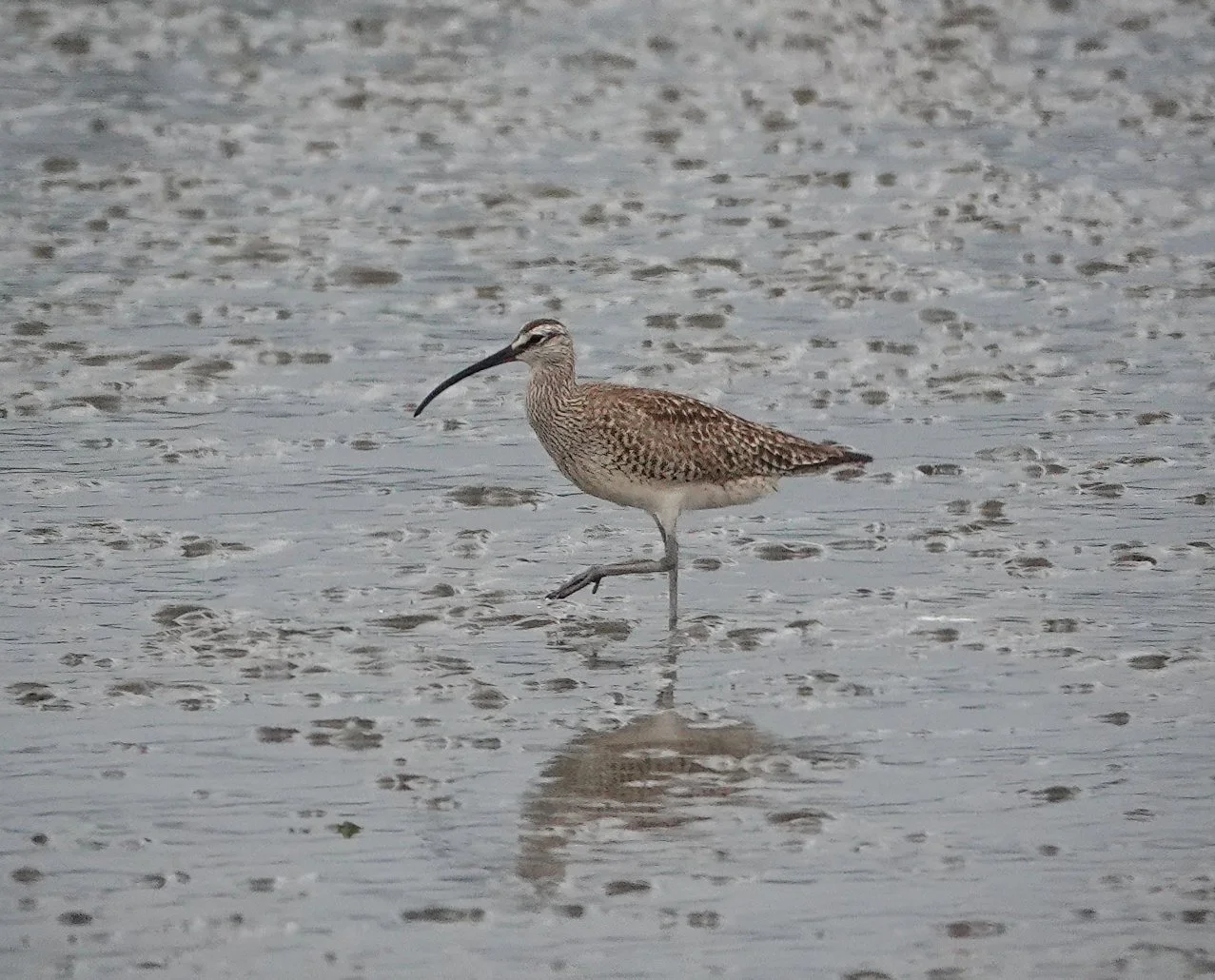
Whimbrel, Jetty Island. Even this shorebird, which weighs less than a pound (450 g), was sinking above its “ankles” in the muck.
Out on the open water, we paddled slowly in the direction of Hat Island, scanning for spouts. After so many years of whale-watching from a kayak, I have developed a good eye. Gray whale spouts resemble a little, white puff of steam, low above the waterline, most easily visible against the dark background of trees and houses on distant Whidbey Island or the mainland. Wind can blow the spouts away too quickly, and chop can obscure the spouts behind the crests of waves, but on this still day of glassy water, it took only a few minutes to spot the first one.
We paddled across the bay, adjusting course from time to time to account for the movement of the whales. At first, we thought there was only one animal, but then we saw two spouts in rapid sequence, faster than a single whale could have produced them. Later still, as we drew within a few hundred yards, we saw three spouts go up at once, and then all three animals began breathing in unison.
Gray whale spout, Possession Sound. The gray whale’s spout is often described as “heart-shaped,” but I seldom see it that way.
Two gray whales, Possession Sound. Gray whales sometimes travel in one another’s company for brief periods, but they do not form longstanding “pods” the way orcas do.
Gray whale flukes, Possession Sound. Most of the white markings on a gray whale are scars left by barnacles that grew on its skin and later fell off.
Gray whale and M/V Tokitae on the Mukilteo–Clinton route. The four boats of the 144-car Olympic class, including Tokitae, are the newest members of Washington State Ferries’ twenty-one-boat fleet.
The gray whales were in a placid mood. They swam slowly and spent long periods at the surface. They did not make long, deep foraging dives. Most of the dives were only a minute or two in duration. From time to time, the whales would synchronize their breaths and all emerge at the same time in the same place.
We stayed a few hundred yards upstream of the whales, listening to their breaths and the occasional splashing of their flukes. At one point, a suspicious disturbance on the water’s surface in front of us prompted us to veer aside, lest we collide with an unsuspecting, surfacing whale.
Everyone felt better after spending a few minutes with the whales. Even Leon reported that he was “already forgetting about the quicksand.”
By the time we were ready to head home, we had drifted far enough south that it made more sense to round the south end of Jetty Island instead of the north end we had rounded earlier in the day. It was a welcome change of course, because the south end of the island is not subject to drying mudflats the way the north end is.
On our way across the sound, we encountered a small pod of harbor porpoises. Rachel was too far ahead to see them, and the kids were too drowsy from sitting in the sun all day, but I enjoyed a couple of very close passes by the porpoises. I was especially happy to see them today because I had missed seeing any porpoises on my last couple of trips in Puget Sound and the San Juans.
Harbor porpoise, Possession Sound. This is by far our most abundant cetacean in the inland waters of Washington State.
Harbor porpoise fin, Possession Sound. Though often easy to see, they aren’t always easy to photograph since they only stay on the surface for a second or two at a time.
Arleigh Burke-class Aegis guided-missile destroyer USS John S. McCain (DDG-56) en route to Naval Station Everett. The ship’s crew were manning the rails in celebration of the ship’s return to homeport after fifteen months in drydock at Swan Island, Oregon, for repair and modernization work.
Kids paddling beneath north wharf, Naval Station Everett. This section of the navy base is used for mooring coast guard cutters.
Rachel paddling beneath north wharf. The wharf afforded welcome reprieve from the sun and tidal currents.
I was glad Rachel and the kids finally got to meet the gray whales. We natives of the Pacific Northwest, human and whale, ought to know one another. An afternoon of visiting with our whale neighbors is part of the adventure of living here.
The quicksand grounding was a little more adventure than I had intended to deliver. Leon may have forgotten his fear by the end of the trip, but he didn’t forget his promise. When I came to bed that night, there he was, curled up and waiting for me on my side of the bed.
—Alex Sidles