My daughter, Maya, and I had been wanting to do a kayak-camping trip together, just the two of us. Maya’s school started spring break a week earlier than her brother, Leon’s, school did, so we had a window in April during which only Maya would be out of school—the perfect chance for us to go on our private camping trip.
By this point in her kayak-camping career, Maya had been to at least twenty different campgrounds in Washington, most on multiple occasions. She had developed a discerning taste for the best kayaking grounds, so I let her pick our destination for this trip.
Maya picked Sucia Island. Sucia is, indeed, one of Washington’s finest islands for kayak-camping. Unfortunately, when we arrived at the launch beach on Orcas Island, we saw that a ten-knot wind was opposing a two-knot current. Two-foot whitecaps covered the channel between Orcas and Sucia. It would be a slow, wet ride in our open-cockpit folding kayak.
Rather than brave the miserable crossing to Sucia, we headed instead for Jones Island. From the Deer Harbor marina on Orcas Island, Jones Island was less than an hour’s paddle through protected waters.
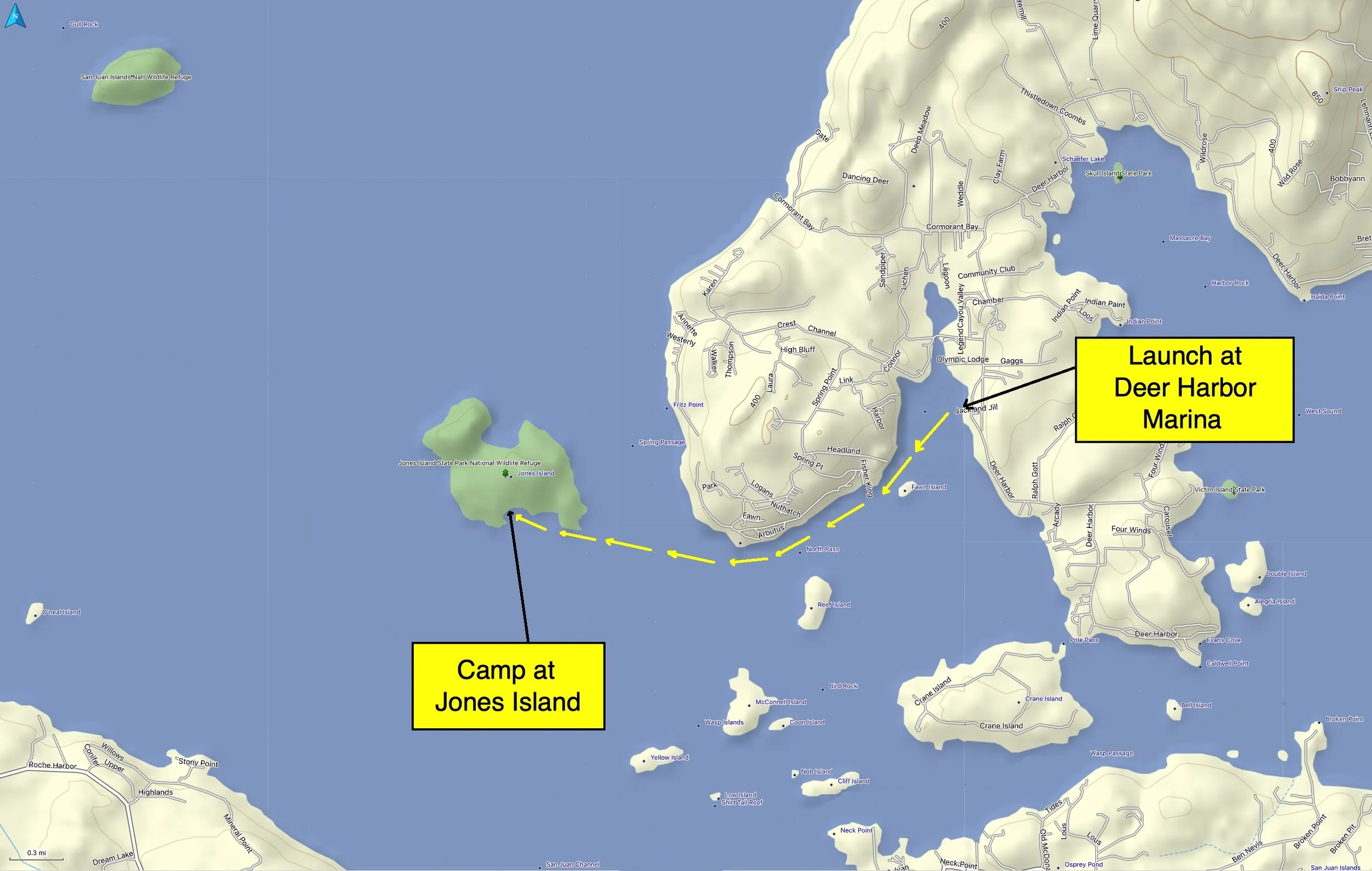
Route map. Staff at the Deer Harbor marina warned me that public parking would be closed for the season starting in May.
My favorite campsite on Jones Island is on a rocky point on the southwestern corner of the island, but that site requires a long carry from the landing beach. Maya chose a closer campsite, in the middle of the orchard. The orchard is usually crowded with visitors during the summer, but at this time, in the middle of the workweek, in early April, we were the only campers.
The orchard was a great spot. We were sheltered from the wind, but we still had a view of the water. There were shady areas to sit when we got hot and sunny areas to sit when we got cold.
Maya and Alex at Deer Harbor marina. At low tide, sinking, stinking, sticking mud made loading the boat a chore.
Maya in kayak, Spring Passage. Maya turned around in the boat so she and I could talk more easily.
Maya walking through forest. Jones Island offers several short hiking trails around and across the island.
View south from Jones Island. I was tempted to paddle across to Yellow Island to see the wildflowers, but Maya preferred to keep our time in the kayak as short as possible.
The birds had begun their spring migration. The woods were full of warblers, especially orange-crowned and yellow-rumped warblers. At the same time, winter residents like the ruby-crowned kinglet had not yet departed for their breeding grounds in the mountains.
Rufous hummingbirds were out in force. The males of this species arrive each spring before the females do, the better to seize the most desirable breeding territories. The males on Jones Island were staking their claims by soaring high into the sky and then swooping low over the treetops, fanning their tail feathers at the bottom of the dive to generate a loud, distinctive buzz.
As dazzling as the hummingbirds’ displays were, the birds that most excited me were a pair of Townsend’s solitaires, which I found on the southwestern side of Jones Island while I was hunting for cell phone signal. These members of the bluebird family are usually found in the mountains or in eastern Washington, but according to Seattle Audubon’s Birdweb, they are also “fairly common migrants on the San Juan Islands in a very limited window of time each spring.” Sure enough, this was my second time seeing Townsend’s solitaires in the San Juans.
Orange-crowned warbler, Jones Island orchard. A handful of orange-crowned warblers stay in Washington year-round, but their numbers explode in springtime with the arrival of the larger, migratory population.
Yellow-rumped warbler, Jones Island orchard. This individual’s yellow throat identifies him as an “Audubon’s” warbler, as opposed to our other subspecies, the “myrtle” warbler, which has a white throat.
Ruby-crowned kinglet, Jones Island orchard. Usually I don’t take many bird photos when I’m camping with the kids, but the birds on Jones Island kept flying into the orchard, right next to our campsite.
Rufous hummingbird, Jones Island. This tiny hummingbird’s annual migration can be as far as 2,000 miles (3,200 km) each way.
Townsend’s solitaire, southwestern corner of Jones Island. The San Juans are the only place in lowland western Washington where I reliably find solitaires.
Out on the water, most of the sea ducks had already departed. We saw no scoters or goldeneyes and only a handful of buffleheads. Hooded mergansers far outnumbered common mergansers, and there were no red-breasted mergansers. The loons and grebes were still present, and all in their breeding plumages. The red-necked grebes looked especially handsome in their seasonal scarlet. Kettles of turkey vultures circled overhead.
We saw no marine mammals at all, not even any harbor seals. The only mammals we did see were on land. A small herd of deer emerged from the forest in the morning to feed on the grass in the orchard. In the middle of the night, the clang of a knocked-over cooking pot announced the arrival of the raccoons for which Jones Island was at one time famous. Only one raccoon appeared this time, and it ran off into the forest when I burst out of the tent with a headlamp.
Red-necked grebe, Deer Harbor. Come summer, these handsome birds will desert our waters for their breeding grounds in the interior.
Western grebes off Jones Island. We saw roughly equal numbers of western and red-necked grebes but no horned grebes.
Pigeon guillemots, Deer Harbor. We saw plenty of guillemots and rhinoceros auklets but no common murres or marbled murrelets.
Turkey vulture circling over Spring Passage. It always amazes me that such a large bird can find enough carrion to sustain itself.
Mule deer eating grass, Jones Island orchard. These are Columbian black-tailed deer, a subspecies of mule deer, although many people erroneously believe that black-tailed deer and mule deer are separate species.
Because the paddle from Deer Harbor was so short, Maya and I had lots of time on Jones Island. We walked across the island to the north beach, where we watched a crew from Washington State Parks reinstall the seasonal dock for the powerboaters. We revisited our old campsite on the southwestern corner of the island, where we camped with Leon and Grandpa John during our last visit to Jones Island, three years ago. Most of all, we made up stories about Maya’s stuffed dogs.
We had planned to stay up after sunset to look for bats, but in the event, we were so tired and chilly that we crawled into the tent and got into our sleeping bags while it was still light out.
Maya at southwestern campsite. Maya didn’t see the need to wear sunscreen when she could just steal my hat instead.
Maya drawing in charcoal on boulder. This is the same boulder Maya and her brother, Leon, audaciously climbed the last time we were all on Jones Island.
Maya peeling bark of Pacific madrone. The unusual bark is the reason this is Maya’s favorite species of tree.
Maya photographing deer, Jones Island orchard. The deer here were not quite as welcoming of humans as the deer on Hope Island.
Maya and Alex in orchard. The picnic tables all got soaked by condensation overnight, so we were glad we had brought our camp chairs.
Maya suffered no end of footwear troubles on this trip. First, she forgot her shoes at the launch beach where she changed into her rubber boots. Then it turned out she had mistakenly brought one of her own boots but also one of her mother’s boots—two different boots in two different sizes and two different heights. The mismatched boots would have been annoying enough just in the kayak, but because of the forgotten shoes, Maya had to wear the mismatched boots the entire trip, including ashore on Jones Island.
The one piece of good luck was that Maya had brought one left boot and one right boot, as opposed to two left boots or two right boots. She was also able to borrow my sandals, although they were so far too big for her that she was better off in the boots.
We packed up after lunch on the second day. It was still a little breezy, at least for a folding kayak, but at least we had it at our backs. What little current was running between Jones Island and Orcas Island was helpful in pulling us toward the east, although it did also tend to pull us a little too far southward.
View from southwestern campsite. The tree species in this photo are the seaside juniper and Garry oak, two dry-climate specialists that prosper in the San Juans but are unusual elsewhere in western Washington.
Maya packing up the dogs. The precious dogs always travel in their own, special drybag.
Alex paddling off Jones Island. Luckily for me the distance from the driftwood line to the waterline was not far, because the 110-pound (50 kg) “Long Haul Mark II Quattro” is a lot for one person to carry by himself.
Kayaking into Deer Harbor. I kept Maya entertained by telling dog stories during the crossing.
As soon as we landed, Maya raced up to the top of the beach, where she found her forgotten shoes. They had survived the night unmolested just above the high-tide line.
Once everything was loaded into the car, we drove down to the ferry terminal an hour early so we could get a couple of cheeseburgers and sit outside together one last time before heading home.
—Alex Sidles