Though I’d done a bit of hiking in October, I hadn’t gone kayaking since September. Two months without a paddle was the longest I’d gone in many years.
To break back into kayaking, I headed out for a weekend on Patos Island, the westernmost of the chain of four state park islands north of Orcas Island in the San Juans.
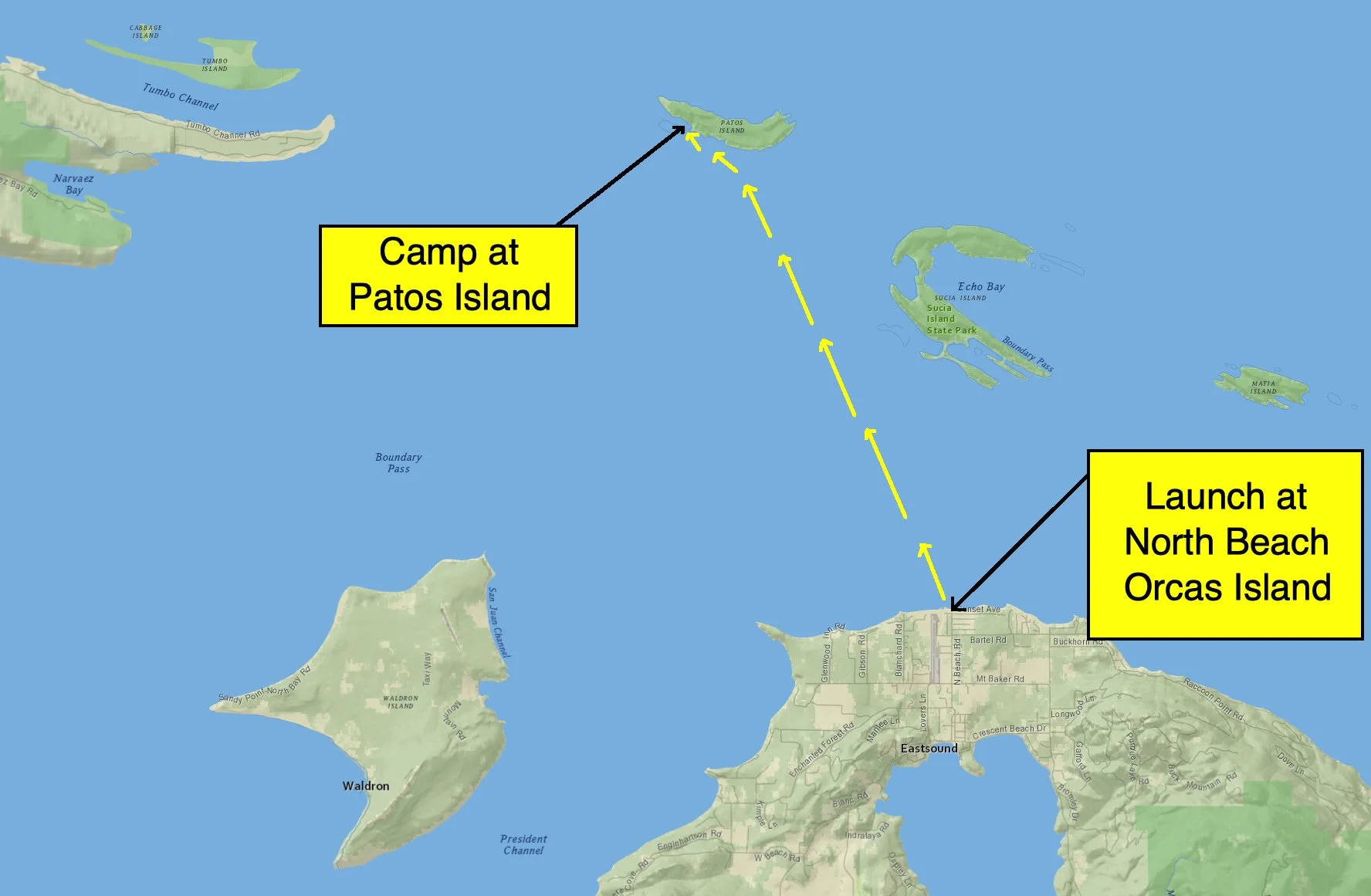
Route map. Patos Island is the northernmost island in the San Juans, closer to Saturna Island, BC, than to Orcas Island, WA.
Seabirds had returned from the freezing north to take up winter residence on our sheltered waters. Surf and white-winged scoters were flying to and fro in small flocks. Common loons and western grebes were present in large numbers, and red-breasted mergansers in smaller numbers. I even came across a single long-tailed duck just offshore of the launch beach, my favorite species of sea duck.
The most numerous seabird was the ancient murrelet. They were here by the hundreds.
It made me laugh to see so many ancient murrelets, because I had made several arduous trips earlier this year to find this species during the breeding season: a difficult attempt on the offshore Bodelteh Islands during choppy conditions in spring, and a very long paddle to Forrester Island, the most remote island in southeast Alaska, in June. Had I only waited for fall, the ancient murrelets would have fallen right into my lap here in the gentle San Juan Islands close to home.
Paddling north toward Patos and Sucia Islands. A couple hours before slack, currents were not significant during this crossing.
Morning mist along the shoreline of Orcas Island. Radiation fog, rising from the forest, spilled across the still water.
Sunrise behind Mount Baker. Baker lacks the overwhelming splendor of the mighty Mount Rainier to the south, but it still exhibits its own kind of lonely pride.
Western grebes off Sucia Island. With its long, slender neck and bold black-and-white plumage, this is perhaps our most elegant seabird.
Ancient murrelet off Sucia Island. It’s possible this individual could be one of the very ones whose breeding grounds on Forester Island I visited over the summer.
Channel between Patos Island on the left and Sucia Island on the right. This channel is known for fast currents, but by chance, I happened to arrive close to slack.
This was only my third-ever visit to Patos Island. It’s an easy island to overlook, since it lies adjacent to, and a few miles farther offshore of, the fabulous Sucia Island, one of the best kayaking destinations in Washington. Most kayakers, including me, prefer make the shorter paddle to the larger, nicer Sucia, instead of the longer paddle to the more humble Patos.
It took just over an hour to reach Patos Island from the launch beach on Orcas Island. It was still early in the morning when I arrived. It was tempting to use some of the remaining day to perform a complete circumnavigation of the island, which I had never done, but there were tide races off Toe Point on the east side that dissuaded me.
The currents off Alden Point on the west side of Patos Island are described in the Coast Pilot as “particularly strong and dangerous” and more “extreme” than the currents off Toe Point on the east side. Reasoning that however bouncy Toe Point looked, Alden Point would look worse, I decided against a circumnavigation and instead headed directly into the campground at Active Cove on the south side of the island.
Kayaking shoreline of Patos Island. Despite its name, Active Cove is well sheltered from the southeasterly winds that prevail at this time of year.
Tafoni along south shore of Patos Island. This honeycomb pattern in sandstone is found throughout the San Juans and Gulf Islands, but the precise mechanics behind its formation are not completely understood.
Harbor seal in Active Cove. The surprising color is due to sunlight reflecting at a low angle off the sandstone cliffs, staining the water and bathing the seal’s head in gold.
Black oystercatcher, Active Cove. A pair of oystercatchers roosted overnight just twenty meters from my tent, seemingly without concern for my presence.
Harlequin ducks, Active Cove. Almost every time I see oystercatchers, I also see harlequin ducks, and vice versa.
Alex in campground at Active Cove, Patos Island. The landing beach here is composed of gentle, pea-sized gravel.
Camping in November is not most people’s idea of fun, so I wasn’t surprised to find Patos Island deserted when I arrived. Two powerboats stopped by over the course of the weekend, one on Saturday, the other on Sunday. In both cases, they tied off to the mooring buoy but then left after a few minutes without coming ashore. It seemed like strange behavior to me, but they probably thought the same thing about my camping in an open field in November.
The lighthouse at Alden Point is probably Patos Island’s chief claim to fame. The lighthouse was built in 1893, but it was automated in 1974, and the keepers’ quarters demolished as a safety hazard in 2005. The only thing left standing today is the lighthouse structure itself, lonely and proud at the very tip of the point.
Like many historic lighthouses, the one on Patos Island has been adopted by a volunteer group who maintain the structure, post signage about the lighthouse’s history, and offer tours during the tourist season. November is not the tourist season, so the structure was locked up tight, thickening the atmosphere of wilted glory that always surrounds a lighthouse.
Other than me, the only visitors to Alden Point were a small herd of Steller sea lions. They were sleeping on the water’s surface when I arrived, but they soon woke up and began chasing each other through the swirling currents.
Patos Island lighthouse at Alden Point, est. 1893. The famous tide rips between Patos and Saturna Islands were rushing past a few hundred meters offshore.
Mount Baker seen from Alden Point. Stratocumulus clouds rolled in overnight and concealed the mountain on Sunday.
Steller sea lions at Alden Point. This time of year, Steller sea lions can be found hauled out on the tips of most of the larger San Juan Islands.
Alex at Alden Point. Even if you are not interested in the history of lighthouses, they’re still good places to visit because they are always sited with commanding views of the water.
Northern flicker, Active Cove, Patos Island. I was watching this fellow perched on top of a Douglas-fir, waiting for him to do something interesting, when he burst into flight, alarmed by the sudden passage of a northern harrier low overhead.
The nearest weather station reported winds of fifteen to twenty knots on Sunday afternoon. The wind didn’t feel as high as that to me, but it was still enough to rob me of my speed. Between the wind and an adverse current, it took about two and a half hours to work my way back to North Beach on Orcas Island.
On the drive back to the ferry terminal, an owl flew across the road right in front of my car. It perched on a sign and peered intently into the grass by the side of the road, obviously waiting for a rodent or other prey animal to appear. The owl seemed content to wait out in the open, in broad daylight, with cars rushing past just a few feet away.
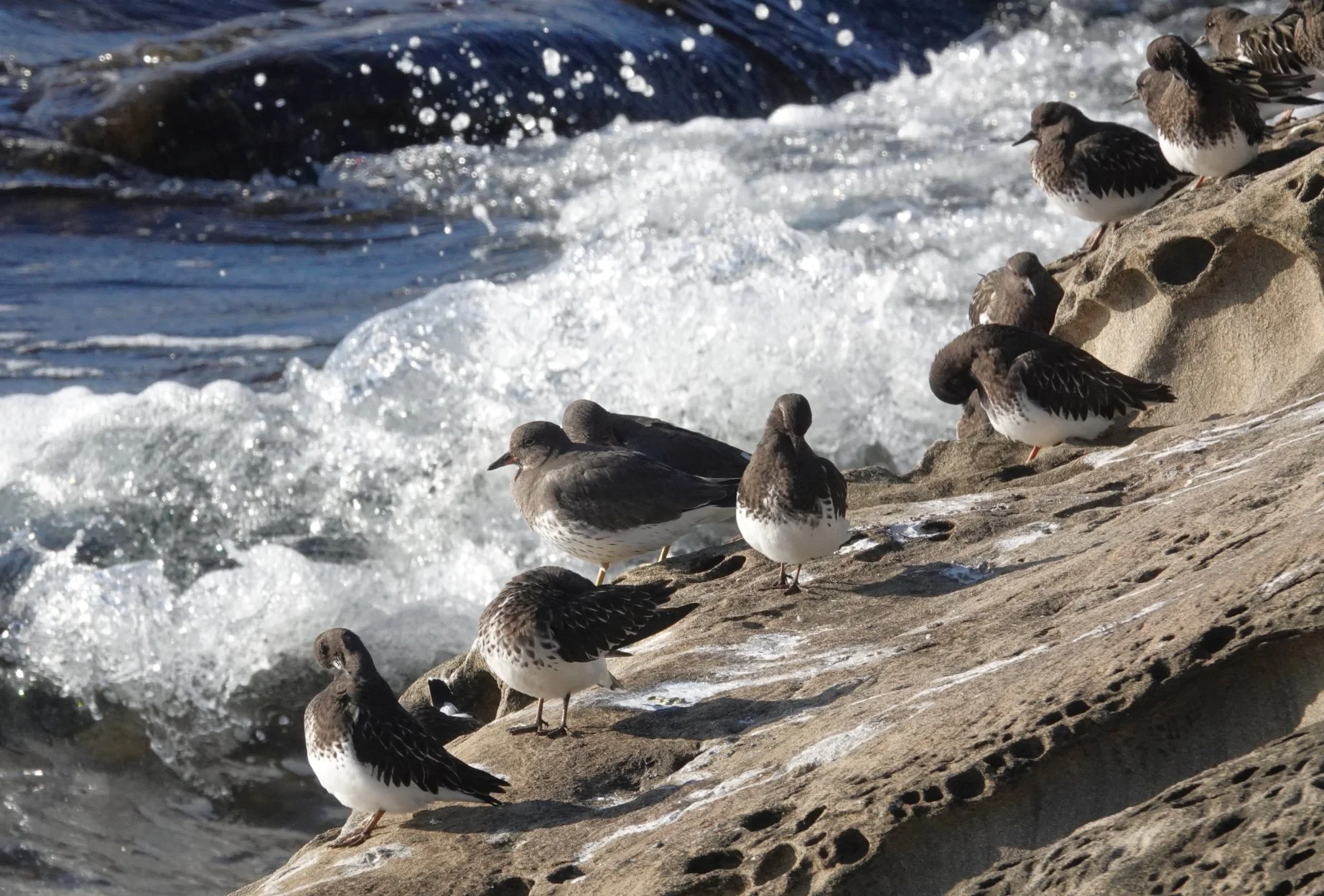
Surfbirds and black turnstones on Patos Island. The surfbirds are the larger, grayer birds with yellow legs, while the turnstones are smaller and darker and have black legs.
Two surfbirds and twenty-six black turnstones off Patos Island. The turnstones have white wing stripes across the width of the wings, plus additional longitudinal wing stripes running front to back near the base of the wing, plus a white stripe down the centerline of the bird’s back, whereas the surfbirds only have the white wing stripes across the width, with no longitudinal wing stripes and no stripe down the back.
View of Sucia Island from offshore of Patos Island. From my side of the channel, I could see yachts moored in Sucia Island’s Fox Cove, which made me grateful I had chosen deserted Patos Island for the weekend.
Paddling south toward Orcas Island. Even on clear days like this, when it’s easy to navigate visually, I sometimes still like to run a GPS to help me account for shifting currents and to motivate me to keep my speed up.
Barred owl, Orcas Island, San Juan Islands. The barred and the short-eared are the two owl species most likely to be seen during daylight hours in the Pacific Northwest.
It had been nine years since my last visit to Patos Island. Whenever I revisit an island after such a long time away, old memories pour back into my mind, surprising me with the recollection of things I had seemingly forgotten.
Sometime in the future, I suppose, the memories of this latest trip will do the same, and I will be surprised anew at the sea lions, the murrelets, the lighthouse, and the owl.
—Alex Sidles